Here’s a fun fact about fraternities and sororities:
all of the stereotypes are true.
Here’s a fun fact about my life:
I founded a multicultural fraternity my freshman year of college.
Here’s how those two fun facts fit together:
although the stereotypes may be true, they don’t come close to giving you a complete picture of what Greek life is like for those who live it. And these stereotypes serve as a crutch for people who are not willing to understand the complex relationships which drive Greek organizations. This is the real issue I have with Alexandra Robbins’ “Pledged: The Secret Life of Sororities,” a decade-old expose of Greek Life which I just finished reading. It does not live up to the promise of the title. The book has no secrets to share. “Pledged: The Secret Life of Sororities” simply regurgitates the common cultural narrative, without trying to unpack why it is that narrative holds such pull. “Pledged” is cheap.
I generally eschew social media trends. Some innate voice inside me convinces me that the wisdom of the masses is a fallacy- that the masses are idiots- and I generally refuse to join in. I’ve been called a hipster. And an asshole.
People are right, sometimes.
Despite this aversion, the recent #100HappyDays trend caught my eye. I’ve been making an active effort to be more positive and happy ever since I watched depression tear a pessimistic hole in them life of someone I loved. Although clinical depression is not something that you can just “shrug off” by “smiling more” or “trying to be happy,” as someone one the outside looking in through the frosted glass of the disease, it’s really hard not to view it that way[1].
So although it was not a viable strategy for my ex-girlfriend, ever since I saw her life collapse around her, I have made a point of smiling more, and trying to do the things which make me happy on a regular basis. Some days I am successful. Some days the pull of routine or of pedestrian concerns is too much, and I go to bed without much to look back on.
Most of us cannot spend every day on jagged mountain peaks[2]. There’s nothing wrong with that; indeed, the realization that life is long and dreary and full of mundane moments is an important part of growing up. But, as David Foster Wallace[3] said in that immortal commencement speech: the real work of life is in choosing how we experience our day-to-day.
Wallace, as a point of record, suffered from severe depression and anxiety his entire life. In 2009, four years after giving that speech, he committed suicide[4].
Finding joy in the day-to-day is really what #100happydays has been about; at least for me. Today marked my 50th day of participating in the #100happydays challenge. I posted a rather shoddy picture of the three baby deer who joined me for dinner. I don’t expect a lot of likes. I don’t like the picture that much. The iPhone camera doesn’t have the zoom to pull off good wildlife photography.
That doesn’t matter though. What mattered was the twenty minutes I spent watching the deer from my porch. I talked on the phone with my mother, something which I should do more. The sun set sagely, and I ate a surprisingly good reheated meal; leftovers from a homemade dinner my girlfriend had cooked two nights back, when we entertained some friends. It was a good moment.
On the other hand:
I had leftovers for dinner. I easily could blow by the moment; complain about any number of things that happened or didn’t happen today. Places I could be or people who haven’t contacted me. Why bother though?
If you are living the sort of life where you cannot find one moment a day which is worth remembering, I think you need to reevaluate your motivations. Too often we just get trapped in the motions, without any motivation.
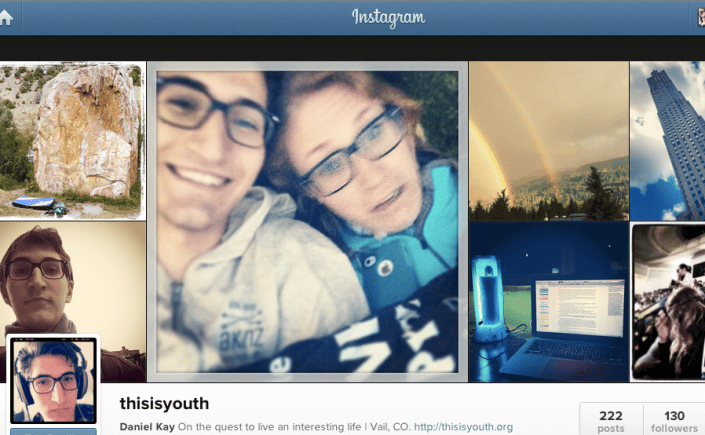
The pictures I see on my Instagram profile remind me what makes me happy. I see the same things recur, here and there, although I’ve been making an effort to keep things varied. I see rock climbing; I see my partner; I see scenes of natural beauty; I see adventure. I see the things I want to post in the future, and I have to say that this is a trend I can get behind.
I can’t wait for the next 50 days.
[1] (This is, of course, part of the vicious Catch-22 in which depression patients are stuck. They feel as if no one understands them or wants them around, which depresses them further, and makes them more difficult to relate to. Of course no one verbalizes this, or confirms it to those in the throes, but everyone understands it. There’s just an innately understood agreement to talk around it.)
[2] In another life, I would be a sponsored European mountaineer, and I could spend all of my time with my head in the clouds. Until I died tragically young, a rope sliced by fate sending me to my doom; a hero’s death or an idiot’s. The line has never been clear to me.
[3] A personal hero of mine, as you might infer from the endnotes.
[4] “Well I can see why he committed suicide,” a creative-writing classmate of mine said after being forced to read this commencement address for an assignment. I cringed, quietly in the corner.
Boyhood is the perfect film for the 20-something zeitgeist.
Or maybe it’s just the perfect film for me.
Not sure there’s much difference in my mind. (I do run a blog called this is youth, after all).
Boyhood is the story of a life. As you’ve probably heard by now, filmmaker Richard Linklater shot the film over the course of twelve years, a few weeks each year. The result is an episodic film that allows the actors to age naturally as the film progresses. This creates an effect that cannot be underestimated or written off as a simple gimmick.
You would be remiss though, to solely attribute Boyhood’s success its unique structure. A victim of its own hype (It currently sits at a 99 percent on RottenTomatoes, and a 100 on Metacritic), many potential viewers are writing this film off as a one-trick pony— a terrible mistake. Boyhood has style, true, but it also has some very deep substance. Boyhood grapples with no less than the meaning of life— more accurately, how we create meaning in our own lives.
The damning thing about Boyhood is that it keeps continuing. With a running time of 2 hours and 40 minutes, the film is by no means concise. I had the opportunity to see Boyhood on a Friday night at the IFC Center in Greenwich Village. I entered the theatre as lines were starting to form outside of bars; people were vomiting on the street when I finally exited.
And yet the film feels so short, in parts. “I thought there would be more,” says Patricia Arquette’s character, crying as she prepares to send her boy off to college. It’s the most gut-wrenching moment in the film, because it rings so true. As the titular character hits the road for college and the end of his boyhood, it’s hard as an audience not to think, “That was it?”
Nothing much happens in Boyhood; at least not in a traditional sense. The three-act narrative is absent. A remedial creative writing teacher would bemoan the lack of a clear beginning, middle, and end. But this is precisely why the film is radiant.
Freytag’s pyramid
I spent my entire childhood wrapped up in escapism of all sorts: videogames, books, cinema and TV. Media, and stories. Stories have a quiet appeal to a kid who can’t find his place; implicit in their existence is the fact that everything will work itself out eventually.
“Everything will work itself out,” is, strangely enough, a phrase you hate to hear, starting at about your senior year of college. It’s not reassuring, although I’m sure everyone who utters it means it that way. I’ll catch myself using it, when I’m not particularly engaged.
The phrase is so irritating because, at this point in your life, you are beginning to realize that stories are artificial constructions. Your life will not work out the way you thought it would; even if it does, it will keep continuing. Life doesn’t end, not really. It’ll keep going and we’ll always keep thinking that there should have been more.
Boyhood simultaneously affirms and rejects the idea that everything will work itself out in the end. And it’s right.




 thisisyouth