The Digital Nomad Deception

HASHTAG DIGITAL NOMAD

“That woman just came in here to take a selfie, then left!” I barely noticed, but the pair of 50-year-old brothers sitting next to me are besides themselves at her behavior. “What’s the point?” they ask.

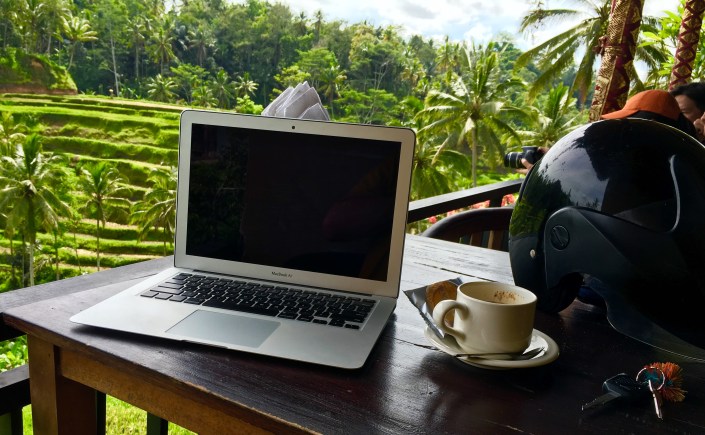
I’m in Hubud, Bali’s hippest coworking space. A bamboo treehouse cum Internet café overlooking the rice fields in the center of Ubud; the place is Instagram-worthy, for sure. It attracts hundreds of pilgrims every month, people who want to wear the moniker of the hippest new trend: “digital nomad.”

https://www.instagram.com/p/1UffAVJsHB/?tagged=hubud


“Can you really be a digital nomad if you don’t Tweet and blog constantly about being a digital nomad?” I ask the man (the irony doesn’t escape me). He just looks back at me, quizzical. “It’s fucking stupid,” he says. He’s been writing code since before I was born.

The laptop in a hammock on the beach is a lie. Everyone knows this. The absurdity of this image is a running joke amongst the people who frequent Hubud. This idea is the face of the digital nomad lifestyle, and you’ll find it everywhere from blog banners to BBC stories to the cover of the digital nomad ur-text: Tim Ferris’ The 4-Hour Workweek. It’s a blatant lie, and it’s everywhere.

But that’s far from the biggest lie the Internet will tell you about the digital nomad lifestyle.

Continue reading

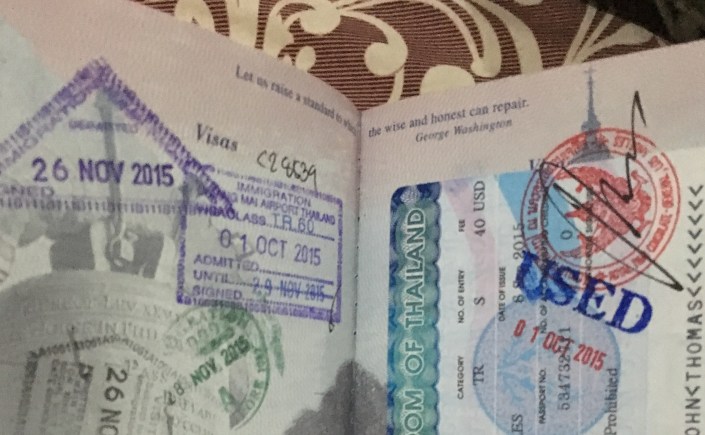
Thailand, Singapore, Malaysia, Bali: A digital nomad diary

Holly and I have been on the road for 10 weeks now, simultaneously traveling and working online; doing the digital nomad thing. We’re not very good digital nomads though; are you really a digital nomad if you don’t tweet and blog about it constantly? It doesn’t seem so.

Gotta sell that lifestyle. (Or that ebook).

I’m a bit conflicted about the lifestyle: it is awesome, but it is also exploitative. Today, I’ll show the awesome side. Next week, we’ll pull out our critical thinking hats and dig into why it’s exploitative.

I bet this post gets more hits.

Continue reading

Zazen, or the Art of Sitting

My girlfriend and I have been in Chiang Mai for two and a half weeks now.

“If this were a normal trip, you’d getting ready to go home about now,” my mother said to me, on the phone—free international communication being one of the luxuries you can easily enjoy in a city as connected as Chiang Mai. “Your bags would be packed.”

This is true, from a salaried, 40-hour workweek viewpoint. That’s the American way— two weeks, paid vacation. Not a second more. Most people don’t even take the full two weeks.

There’s too much to be done. Never enough time.

That mentality remains even when Americans are on vacation— we are over-programmed, trying to cram in so much, check off so many boxes, that nothing really registers. You can fly through New York City in a week, do twenty things, and leave without any real appreciation for the place. I took that trip, last year, in New York. I love New York, but the magic escaped my companion. We are not taking that approach in Chiang Mai.

After nineteen days here, I barely feel like I have my feet on the ground.

IMG_0207

I love lingering over my — often WITHOUT a laptop.

My everyday routine looks something like this: Wake up late. Get breakfast, or get lunch and call it breakfast. Grab a coffee or two. Read. Write. Linger. Grab dinner, maybe a few drinks. Take in a Thai street performer covering Western songs. Go home early in the evening, catch a weird English movie on TV, and hit the hay. Wake up at some ungodly time, work a few hours on U.S. time, then go back to bed. The sun’s rising over the city at this point.

My sleep schedule is shot, but I don’t mind it.

What else do I have to do?

I am ostensibly doing the same things in Thailand that I was doing in the U.S.— eating, sleeping, dating, working, and writing. I brought my two most important possessions with me: my laptop and my climbing gear. I didn’t sell everything else, but I probably should have.

What else do I need?

I am living the same life I was in the U.S., but I am saving more, eating better, and learning more than I was in the U.S. I am living better, for a quarter the cost.

Why would I be anywhere else?

Life here is only beginning to click. The pulses and rhythms of daily Thai life are getting their tendrils around me, and my mindset is beginning to relax. I plan to take up a daily meditation practice. Free of the cultural cage, my brain is beginning to breathe.

Doi Suthep Thailand Prayer Flags car port

Zen Buddhists call seated meditation “zazen.” Zazen is the practice of clearing one’s mind. It is the process of accepting; of “just sitting.” It is the simplest concept in the world, and simultaneously it is completely incomprehensible.

Zen isn’t sensible. By it’s very construction, Zen cannot be understood logically.

To the owner of an overactive brain like mine, it can be an extraordinarily appealing philosophy.

The Buddha is everywhere in Thailand.
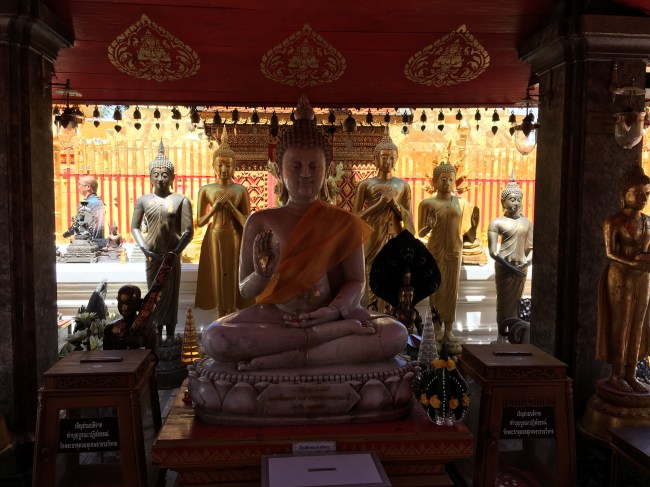
Gold Buddha Images in Thailand

Here, things are slower; simpler; regenerative. The possibilities are endless, but pursuing them never feels necessary. A day spent sitting in conversation over food and coffee is just a day. In the states, I might feel like I was negligent with the day, working too little towards my future. On a shorter trip, I might feel like I wasted the day by not pursuing a unique activity. During long-term travel though, that’s not a good day or a bad day. It’s just a day.

How long has it been since you had a day like that? Don’t keep reading— sit, really take a moment and consider the question. It will be further past than you think it is. Not an average day: a daily day where you breeze through it, half present and half-worried-to-death. When was the last time you just lived a day, quiet, content, and totally mindful of the experience?

Those periods of content are few and far between, especially as a young person. I’m not sure most millennials know how to experience that feeling, with social media malevolently tugging at your marionette strings.

The magic of travel, for me, so far, lies in the feeling of escape from the puppetmaster. Travel is an experience which transcends social media— I am still playing the game, but I know it is futile. There is no way to accurately portray this time in my life. It’s impossible, and everyone knows that. It cannot be communicated through a photo, which is perhaps why travel often makes people so jealous.

Photos are the worst part of the experience.

As a consumer of someone else’s travel, you always want to know what is beyond the frame. As the traveler, you always feel frustrated being unable to properly portray what lies beyond those artificial borders. It is unsatisfying for all, which is why your friends rarely discuss their travels in details when you ask. It is fruitless.

Real life isn’t the highlight reel: it’s the out-takes.

The two-week vacation is highlight-reel travel. By making such an effort to curate and edit your experiences, you often can return home having experienced nothing at all.

Since arriving in Thailand two and a half weeks ago, we have visited exactly one tourist attraction, the Wat Doi Suthep. The experience was enlightening, the tourist crush a loud, obnoxious contrast to our quiet, reserved, and altogether everyday experiences elsewhere in the city.
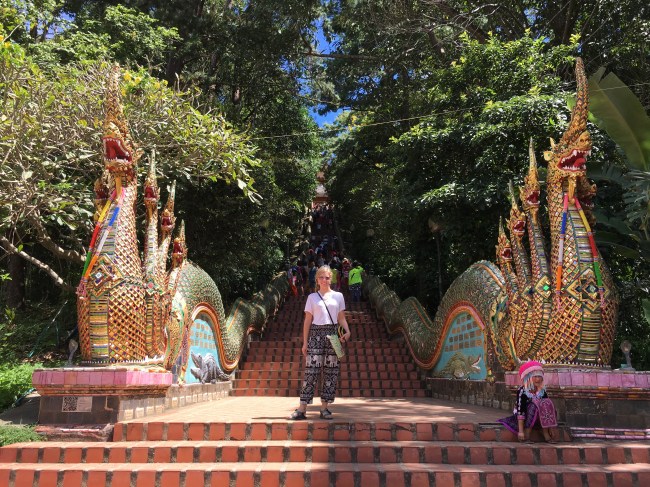
Naga Stair Doi Suthep

Although the sort of stuff pictured above is what you will see on Google when you search for info about visiting Thailand, to me, Thailand is a good cup of coffee. It is walking down unremarkable alleys in search of a new restaurant; it is the workmen all around who are ALWAYS building. Life as a nomad passing through this city for more than a little while is not about tourism; it is simply about living life, as quietly and as best we can.

Obviously, the longer we remain, the more things will change. More connections will form, and routine will set in, in some way, as it always does. But those things aren’t necessarily bad. Standing brunch dates, Skype calls, and co-working sessions will emerge— some have already begun. A life is coalescing around us.

The key difference, I think, can be glimpsed in the phrasing I chose: “coalescing.” A word which came through my fingertips without any thought— simultaneous prose, a perfect word. Life does not coalesce, in the states. You are constantly pushed to be better, to do better, to MAKE a better future for yourself. This pressure comes in many forms, obvious and subtle, but it comes from all angles. From the moment you are born until the moment you make peace with your life, you are cooking under pressure.

And if you decide to ignore that pressure, you are often shunned. Those that see a good life coalesce around them in the states are ostracized, accused of privilege and not earning their spot. Misplaced belief in meritocracy dominates the U.S., and it’s hard not to buy in.

“I know I’m amazing,” your monologue says. Your parents say. Your culture says. And when the external world doesn’t validate that internal monologue, things start to get unpleasant inside your head. Everything gunks up, and you start questioning things which should be automatic. Self-esteem and cultural validation kick in, and suddenly you aren’t even getting that many Instagram likes so what is wrong with you why is it soo deeply rooted and will you ever overcome it?

Your brain becomes deafening. And amidst all this noise, it becomes impossible to take the steps which need to be taken to placate that self-doubt. You become trapped by your culture, and yourself.

Being surrounded by a foreign culture forces even an overactive internal monologue like mine to hibernate, while baser brain functions come into play. This is the great benefit of travel. It instills a sense of focus and calm, almost like a meditative state.

Here, one can just sit.

What Can We Learn From an Ancient Buddhist Temple Swarmed With Chinese Tourists?

Naga Stair Doi Suthep

The number one tourist attraction in Chiang Mai, Thailand is Wat Phra That Doi Suthep, the temple on the mountain above the city. For tourists, it is colloquially referred to as Doi Suthep.

Doi Suthep is a Theravada Buddhist temple, built in 1383. The temple is located atop Doi Suthep, the mountain just outside Chiang Mai. As legend has it, the site was chosen by a white elephant. The elephant was released into the wild carrying a sacred relic. Eventually the elephant wandered to the spot of Doi Suthep, trumpted three times, and then died. The king of Lan Na (Northern Thailand) took it as an omen, and ordered a temple built upon the spot.

Over the years the temple has been expanded and embellished, resulting in an ornate complex plated in gold and adorned with hand-painted murals from the life of the Buddha.

Bells and pagoda at Wat Doi Suthep in Chiang Mai, Northern Thailand

It’s an astonishing sight.

If you can see past the thousands of tourists.

Continue reading

A Local’s Guide to Recreational Marijuana in Vail, Colorado

Native Roots Eagle Vail

“You’re from Colorado huh? How are those new weed laws treating you?”

Colorado Flag Pot Leaf

This is the first thing anyone ever asks me when I leave the state. No one wants to know about anything in Colorado except the recreational marijuana. Prior to the passage of Amendment 64 that question was “oh you’re from Colorado, do you guys like ski and snowboard every day?” (only the really lucky among us).

Since most of my readers are from outside of Colorado, allow me to answer the above question for you.

Marijuana has been a part of life in Colorado as far back as I was aware.

Growing up in Boulder, Colorado, it was more uncommon to find someone who didn’t smoke than to find someone who did. Now Boulder is “nine square miles surrounded by reality,” as the saying goes, but I’ve lived up and down the front range and now in the mountains, and this attitude isn’t limited to Boulder. When someone in Colorado asks you if you smoke, they’re usually not talking about cigarettes.

Recreational Marijuana has changed little in Colorado. It’s unobtrusive and it’s convenient. It’s expensive. It matters more to the tourists than it does to the locals.

Marijuana tourism is a huge industry here in Colorado, and the shops have only been open for a year. Tourists are allowed to purchase marijuana products, but are restricted to a quarter of an ounce. Let me reassure you: if you are the type of person who is traveling to Colorado to buy your weed, a quarter of an ounce will be plenty.

A guide to marijuana tourism in Vail

  1. Marijuana is technically illegal to use on Vail Mountain and in the town of Vail
  2. There are no recreational marijuana shops in Vail
  3. Neither of these things present a significant challenge if you want to check out Colorado’s pot shops while you are on vacation in Vail.

Can international travelers buy marijuana in Colorado?

Yes. You must be over 21 with valid ID.

How do I purchase marijuana in Colorado?

It’s honestly nothing intimidating— about the same as purchasing beer at a liquor store. Upon entering the store, you will be required to show a valid driver’s license to prove you are over the age of 21. Recreational marijuana sales are limited to those above the age of 21. Those underage cannot even enter the stores.

Most stores won’t take down your information or put you into any sort of database, so you don’t have to worry about being tracked or entrapped or whatever else your paranoid mind will can come up with after you’ve indulged in a joint or two. I have not heard of any stores in the Vail Valley which take permanent customer records.

After your ID is verified, you may be asked to wait in a lobby if the store is busy, or you may be shown into the bud room. If you have to wait, the dispensary will usually have menus and educational material available for your perusal. I would suggest reading the edible education card, lest you end up like hapless NYT columnist Maureen Dowd.

Tips on edible dosage

Once you are allowed into the bud room, you will wait in line and eventually talk to a budtender at the counter. This person can educate you on the wide variety of marijuana products available. This selection can be a little overwhelming for some people. As a tourist, stay away from some of the more gimmicky products, such as lotions and bath soaks, as these can be both gimmicky and expensive. Pre-rolled joints and vaporizer pens are safe, simple choices.

Make sure to factor a 30 percent tax onto any prices which are told to you— this hefty tax rate is used to support Colorado schools and other public works. It is a huge part of how Amendment 64 got passed and is a necessary evil at this point.

Where can I buy legal weed in Vail?

The town of Vail has no recreational marijuana shops as of January 2015. However, there are several only five minutes down the road in nearby Eagle-Vail. Many tourists charter taxis over to the shops. Some shops, such as Native Roots in Eagle-Vail, have partnered directly with taxi companies to make things even easier.

The Eagle-Vail dispensaries are the closest to Vail Mountain, but there are many other options throughout the Vail Valley, including in Eagle and Edwards. There are also a few recreational pot shops in Glenwood Springs, if you fancy a soak in the world’s largest hot springs pool after a few days skiing on the mountain has worn out your legs.

steamy hot springs winter night Glenwood Springs Colorado

The Glenwood Hot Springs is only a one hour drive from Vail, and an excellent way to close out your trip

Weedmaps.com provides an interactive, searchable map and database of the shops in the Vail Valley area, as well as elsewhere around CO.

How do I pay for recreational marijuana?

Cash, credit or debit are accepted at most shops. If a shop is cash-only they will always provide an ATM. You should not need to worry about this aspect.

Can I make a late-night run for pot?

No. Colorado law requires all transactions at these recreational marijuana shops to be closed before 7:00 p.m. This means that you should arrive no later than 6:30— the shop cannot legally sell you anything after 7:00 p.m., even if you are waiting in line.

What is the price of recreational marijuana in Colorado?

You can expect to pay 10-15 dollars for a joint of good quality bud, with occasional discounts or specials available.

Edibles will generally run between 10 and 35 dollars, depending on the concentration of THC. For a casual user, a 10mg dose of THC is usually more than enough to get quite stoned. The strongest edible legally allowed in Colorado is a 100 mg package. Be sure to examine the packaging or ask the budtender about the strength of the edible you are purchasing.

Marijuana by weight tends to cost around $20 a gram and $50-70 for an eighth of an ounce. The price you may have paid in high school, if you were buying illegally. Marijuana in the Vail Valley is extra pricey, like almost everything else in the area. Side effect of so many affluent tourists coming through. Prices are somewhat lower in other areas of the state.

If you are from Colorado many places will offer a local’s discount or an exemption on sales tax, so be sure to ask about that.

You can peruse the menu of the Eagle Vail Native Roots dispensary online to get a more thorough picture of product pricing.

Can I fire up a joint on the chairlift?

Legally: no. Practically: yes. While marijuana consumption is technically illegal on ski resort property, no one is going to bother you about it unless you are being a jackass. Be considerate of other people and the fact that a ski resort is a family destination, and you should be fine.

Where can I smoke weed in Vail?

Technically, if you are a tourist staying in a hotel, nowhere. Smoking marijuana in public is still illegal under Colorado law, and there are no cafes or bars which allow the activity yet. (One cafe in Nederland does allow indoor smoking but Nederland is a town full of old hippies and I’m pretty sure local authorities are kind of just looking the other way on it). But, as I said in the previous section: if you are reasonably discreet and not causing a public nuisance, you generally will not be bothered. Vail wants your money too much to make harassing you a priority.

In 2014 Vail police handed out only 19 citations for public consumption of marijuana, roughly one point five a month. So again, let me emphasize: be considerate and discreet, and you should be fine. If you know a local, you can smoke in their place of residence.

Marijuana is part of the ski town culture in a lot of ways, so although Vail does not like to emphasize it, it is there and it is accessible.

(As are many other substances rich people often indulge in, but that’s a post for another day).

Can I take recreational marijuana home with me?

If you are flying back home, then no. If you try, you will get caught. Period.

If you drove to Colorado and plan on driving back to your home state, then you could try and risk it. Bringing recreational pot outside of Colorado is illegal, but as you can imagine it does happen. Cops and state patrol in neighboring states are quite aware of marijuana bleeding out of Colorado, so be extra careful to properly seal your products and follow all rules of the road. It’s not the smartest idea, but if you think it’s worth the risk you’re welcome to try. Just don’t say I told you to.

If you have any other questions you’d like answered, leave them in the comments. I’ll respond.