Christopher Nolan’s “Interstellar” is less than stellar

Christopher Nolan is one of the best mainstream filmmakers working today. There are better, I won’t argue that with you, but there are only a select few artists in the mainstream who can consistently make blockbusters that are as visually pleasing, thought-provoking, and tense as those that bear the stamp of Syncopy, Christopher Nolan’s production company.

Nolan is one of the only filmmakers whose movies I will see without knowing anything about them. I went into “Interstellar” having seen a trailer or two, and not much else. I knew it was sci-fi, a genre I love, and from a man whose previous original projects included “Inception,” “Memento,” and “The Prestige.” Those are all fantastic mind-bending films which have a lot of flair. It’s hard to argue with a pedigree like that (although many online Steven Spielberg fans will argue with you about it until neither of you enjoys the discussion anymore).

Interstellar tries really hard to fit the same mold, but it just didn’t work for me in the same way Nolan’s earlier films did. Simply put: Interstellar is a decent film, but I left it in the theatre (along with eighty dollars, but that’s another story). My mind was already on tomorrow by the time the lights came up. I didn’t find myself immediately wanting to rewatch it, which is the way I felt after “Memento,” “The Prestige,” and “Inception.”

This may be because Interstellar uses less sleight-of-hand to keep audiences guessing.

Although the plot of the movie (I’ll keep it vague, promise) revolves around some fairly advanced astrophysics, information or understanding is never withheld from the audience. The critical scenes in the movie all have clearly defined stakes and rules. The movie progresses from plot point to plot point in a linear fashion. And even when the film ventures into strange territory and advanced theoretical concepts, there’s never much of a sense of mystery or wonder.

The cinematography is jaw-dropping and breaks its back to instill meaning and scale into the void left by a compelling plot. The score by Hans Zimmer is well-constructed, but unobtrusive (not usually a word I would use to describe the work of Hans Zimmer).

Matthew McConaughey as Cooper is the emotional center of the movie, and it is largely the strength of his performance that anchors the movie. Nolan clearly understood this, as he hangs the success this film on emotional appeal.

I’m a cerebral person. Although I can appreciate a good tearjerker or a quiet movie which silently swims on emotional subtext, I’ll take the guessing game of “Memento” over that stuff any day. At least in a Christopher Nolan film.

I left the theatre underwhelmed; my girlfriend came out sobbing.

I can’t say that “Interstellar” was a bad film; it clearly connected with her, and others I have spoken to about the film echo her sentiment. The film strikes a resounding emotional note. And for some people, that’s enough. Strike that note in the cold vacuum of space though, and it produces no sound.

Wherein I spend $80 seeing a movie at CinéBistro

Wine in movie theater

I took my girlfriend to see “Interstellar” this past weekend (Review here). We decided to do “dinner and a movie” on Sunday night, to celebrate her starting work (I work from home, and let me tell you, that’s difficult to do when your unemployed girlfriend is walking around in her underwear all day). This was a cause to celebrate, at least in a modest “dinner and a movie” way.

Dinner and a movie, Vail style, is a $100+ date. We spent $80 at the movie theatre.

Vail, 1, thisisyouth, 0.

Vail’s only movie theatre is, unsurprisingly, an upscale affair. Cinébistro at Solaris is a full-service concept, with menus and waiters and wine. It is without a doubt the nicest movie theatre I have ever been in.

The seats are leather, the leg room is spacious; Like most places in Vail, something about it really reminds me of money.

And that’s the thing.

Cinebistro makes it so incredibly easy for you to spend money. This, of course, is the goal of any movie theatre, with their $7 popcorns and $5 drinks and pulling you out of your home to do an activity which you could do from your couch. They trade convenience and the feeling of larger-than life luxury for extortionate sums of money. Cinebistro is maybe the apex of this idea.

When we arrived at Cinebistro on Sunday night, we had already eaten dinner and had two drinks apiece at the cheaper places in town. “Oh you guys are going to see Interstellar? I’m so jealous! I really want to see that movie. Isn’t it like three hours long though?” A bar worker asked us while we sipped on cocktails. “Yeah, that’s why we’re getting a little buzz on now,” I told him. “Very smart,” he said.

We had specifically chosen to eat and drink elsewhere because we did not want to spend too much money at the Cinebistro. Smart thinking that did not get us far.

Roughly 10 minutes before our screening, we arrived at the CInebistro. We paid $24 for two tickets (with the local discount), and reserved a pair of seats recommended by the clerk, which allowed us to extend the already spacious legroom by putting our feet up on the railing.

Thirty seconds after we sat down in the theatre, a waiter arrived and asked us if we would like some drinks. Two drinks deep already, of course we would like more. We order the cheapest bottle of wine on their menu and popcorn, and are out 56 more dollars. We are charged an automatic 18 percent gratuity for in-theatre service. From the time we entered the theatre to when we ordered food, maybe three minutes elapsed. There was little to do but laugh, exasperated, and say to one another, “We just spent $80 at the movie theatre.”

The movie was good. The experience was great. I’m still trying to come to terms with the fact that two of us spent $80 at a movie theatre.

Much like Las Vegas, Vail is a town designed to make you spend money.

I told this story over beers, to a group of pink-faced Vail Resorts employees who had been in town for all of two days; homeless and full of idealism. They all immediately pointed to our purchase of concessions as our issue. Which is obviously true. If we had skipped on snacks it would have been a much cheaper excursion.

A few weeks earlier, we saw “Gone Girl” at the Riverwalk Theater in Edwards, a town slightly down-valley from Vail. We drove ten minutes to the theatre and did not purchase concessions. It was a much cheaper outing (and for my money, the movie was better). But Edwards and Vail are very different places.

Vail is a resort town, an experience. To live in Vail without having the experience feels like a huge waste. Sure, you could skate by skiing, working, and drinking when you have the money, but why? Why live in a resort town if you’re not willing to make a little bit of every day a vacation?

If you’re not willing to do that, your heart seems like it would fill up with toxic hostility and resentment, full of the things you feel you can’t do.

This economic tension is one of the deep-rooted forces acting on the community of Vail. I’m very privileged to be able to thread the line of haves and have nots, but honestly, I can’t see doing it any other way.

Sometimes you need to eat rice for a month so you can afford an EPIC Pass (still waiting on mine to come in the mail, eek!), and sometimes the heart just needs an $80 movie.

“Money’s money.”

I infuriate my girlfriend whenever I tell her that. Usually this is in service of a “money’s not everything/ a poor craftsman blames his tools,” type of message. Her attitude is a little different. She has less saved up.

Money gives me a lot of joy, personally. My mother and my sister often took loans from me while I was growing up. I take good care of my finances; I acknowledge that a large amount of societal privilege has contributed to my possessing both money and the skills to manage it.

However, money’s never been the thing for me. You can’t put a price on experience; living life well is always more important than making money. This is why I’m here, blogging, working towards an audience and experience and a goal, instead of sizing boots or flipping burgers for $16 an hour in the town of Vail.

This is why I’m in Vail, to a large degree.

I work a day job, of course. Two, in fact. Hopefully more, if the tendrils I have laid play out. But you need to work for more than money, even at this age. If you are measuring your life in terms of how many $80 movies you can attend, something isn’t right.

But one every now and then sure doesn’t hurt.


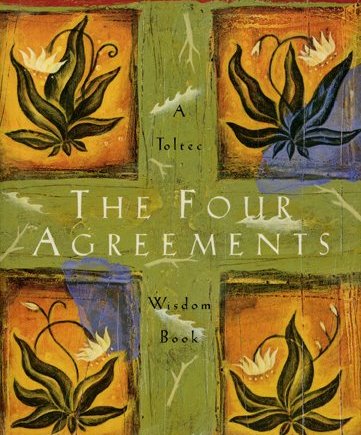
Book Review: “The Four Agreements”

Toltec Wisdom Book

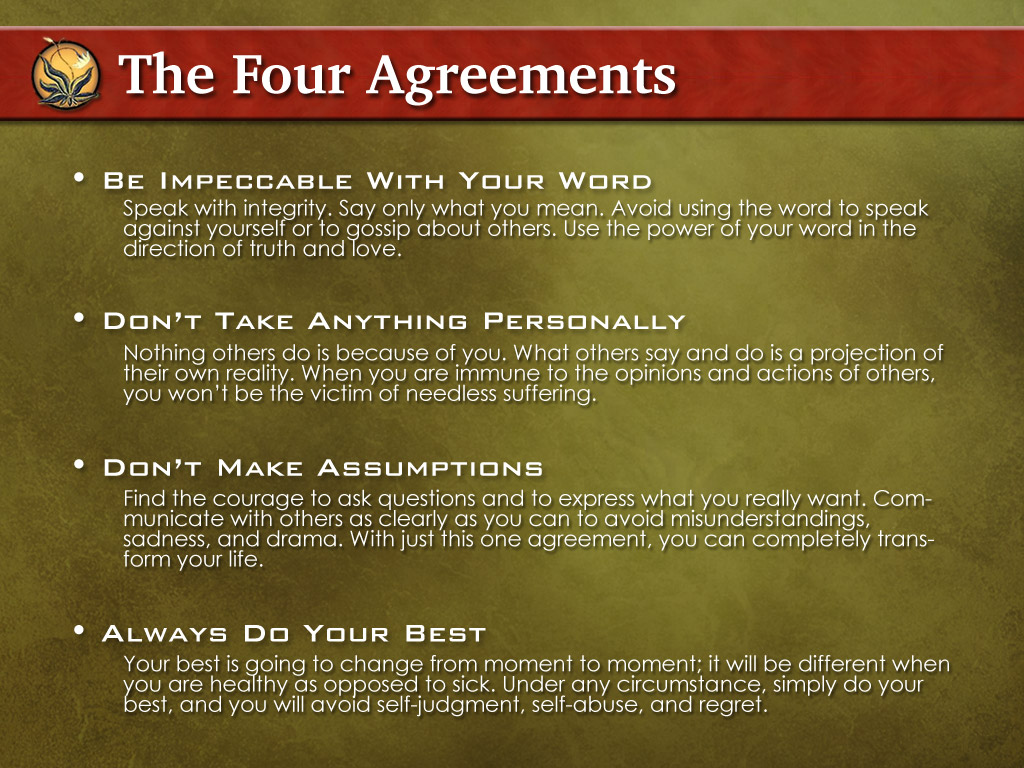
My father gave me “The Four Agreements” by Don Miguel Ruiz for my birthday. My father is one of the most evenhanded people I know: he rarely gets angry, loses his composure, or even raises his voice. He practices Tai Chi twice a week. He’s pragmatic. He lives a simple life, not full of overmuch excitement, but also not full of any reversals of his good fortune.

I have learned a lot in recent years from my father. Once I decided to start paying attention, I found a lot of myself in him. Not an uncommon situation, I don’t think.

Right on the cover, “The Four Agreements” proclaims itself as a “practical guide to personal freedom.” Not many people are very free in today’s world. Whether its their iPhone, their spouse, their lack of funds, their anxiety, or their crippling fear of missing out, almost everyone I get to know has a laundry list of issues and neuroses which seem to interfere with their lives. I have my own, of course.

I run a blog called “This is youth.” I have a staked interest in making myself as free as possible.

I read “The Four Agreements” in one day. It is a short book, 140 pages double-spaced. The tone is conversational. The pages fly. This book is worth your day.

(But if you're too lazy, here's the basic Toltec thesis for a good life)

(But if you’re too lazy, here’s the basic Toltec thesis for a good life)

“The Four Agreements” puts forth a framework for experiencing the world based on ancient Toltec teachings. The philosophy of the book reminded me of Zen, in the way it advocates flowing with the world and letting go of resistances and ties to the past. These four Agreements in the text essentially recommend stripping away as much of the societal framework from your thinking as possible. It is not stated directly as such, but it’s hard to imagine the Toltec approving the way thousands of little ties with which we restrain ourselves every day.

Grudges, assumptions, personal feelings, what-if scenarios. These are all black situations which Don Miguel Ruiz advises you to leave behind. He encourages readers to embrace every moment of life anew, the way a child does.

While this line of argument may seem naïve and impossible, I challenge you to think about your own life. Things are usually best when we are fully in the moment, not preoccupied, not judging, not answering work e-mails on our smartphones. It is a difficult concept to consider, but really, why can’t we live our lives that way all of the time?

It may be idealistic, but hey. This is youth.

The problems with “Pledged: The Secret Life of Sororities”

Pledged

Here’s a fun fact about fraternities and sororities:

all of the stereotypes are true.

Here’s a fun fact about my life:

I founded a multicultural fraternity my freshman year of college.

Here’s how those two fun facts fit together:

although the stereotypes may be true, they don’t come close to giving you a complete picture of what Greek life is like for those who live it. And these stereotypes serve as a crutch for people who are not willing to understand the complex relationships which drive Greek organizations. This is the real issue I have with Alexandra Robbins’ “Pledged: The Secret Life of Sororities,” a decade-old expose of Greek Life which I just finished reading. It does not live up to the promise of the title. The book has no secrets to share. “Pledged: The Secret Life of Sororities” simply regurgitates the common cultural narrative, without trying to unpack why it is that narrative holds such pull. “Pledged” is cheap.

Continue reading

Ski Town Radio— 104.7 The Mile

Snowboarder with headphones

104.7 The Mile is the greatest radio station I have ever heard.

Quick, listen to it here before we go any further: http://www.themile.fm/

Keep it on while you read.

And yes, that is their whole website. This station is so old-school they don’t even produce web content. I LOVE IT.

I’m a music guy (or at least I aspire to be). I read the blogs; I read music boards occasionally; I know as soon as the latest TaylorSwift.1989.320.zip hits the web (Has not hit, as of yet). I love curating playlists and discovering new artists via Spotify, and playing what I hope people will like and have not heard.

Music is an active experience for me.

And yet, since arriving in Vail, I mostly listen to the radio. And on the radio, I almost exclusively listen to 104.7 The Mile.

104.7 The Mile (why yes, I have been working in search engine optimization, how’s my keyword density?) is pretty much exactly what I imagined a ski town radio station would be like ever since I put SSX 3 in the Gamecube.

104.7 The Mile plays the greatest mix of songs, on top of the best music: commercials ratio you’ll hear anywhere this side of college radio. Actually, I’m sure that my former college’s radio station KCSU plays more ads than 104.7 The Mile does. KCSU is a little edgier, but you don’t really need edge in Vail, Colorado. Vail’s really not such an edgy town. As Vail Resorts is happy to remind it’s employees, Vail has brand standards. Rich people come here to relax, not to be offended. The locals just try and slip between the cracks.

EVEN BETTER, 104.7 The Mile has local news, recorded daily (of surprising importance in the Vail Valley, I’m discovering). These news breaks are also a great way to learn about local events, which are always going on in the Vail Valley.

Most importantly, since Vail and Avon are ski towns, 104.7 The Mile gives the weather forecast multiple times a day, so you can plan your days and your days off to take maximum advantage of the world-class skiing provided by Vail and Beaver Creek. I have to say though, these weather forecasts are not very useful. The meteorologist, Stacy Donaldson, never gives any estimate about snow accumulation. I understand that you can’t always accurately predict the weather, but this being a ski town, it would be nice if she differentiated between 1 inch of snow and a 16-inch powder day. As it stands, I need to resort to OpenSnow.com for my detailed ski forecasts. That’s a minor inconvenience though.

104.7 The Mile is an awesome station that plays perfect music, keeps the advertising to a minimum, and provides timely, useful information.

Basically, this is the greatest radio station I have ever heard.
(I don’t work there.)
(But I would really like to. Seriously. Hit me up, 104.7 The Mile. Vail is expensive.)