“The Hanging Tree” Remixes

The Hanging Tree Mockingjay Scene

EDIT: Official Remix

EDIT: Republic Records has released a Radio Mix for “The Hanging Tree.” This remix has been dubbed the “Rebel Remix.” You can download an mp3 of the radio mix on Mediafire, or you can buy The Hanging Tree (Rebel Remix) on iTunes by clicking here. The remix has charted on the Billboard Top 100 and been receiving radio play. Guess we aren’t the only ones who saw the remix potential with the acapella. For what it’s worth, I think all of the below are better, more textured remixes. Unfortunately though, you can’t buy them on iTunes.

ORIGINAL POST

I saw “The Hunger Games: Mockingjay Part 1” tonight (Only spent $54 at Cinebistro this time). The movie is mediocre. The only moment of strength or emotion comes courtesy of Jennifer Lawrence’s haunting performance of an original song “The Hanging Tree,” set over images of revolution.

The lyrics to the song were taken from the Mockingjay novel and set to music by the indie-folk band the Lumineers. There is no version of “The Hanging Tree” sung by the Lumineers, unfortunately (I bet it would be great). The song provides the movie with a much-needed emotional punch. While there is an interesting story to be told about war propaganda, Mockingjay Part 1 does not ever elevate beyond a boring semi-action movie. You’d have thought the split to two movies might have allowed the producers wider thematic latitude, but I guess you don’t take chances with a franchise as big as The Hunger Games. You don’t have something to say, you just have a good story to tell.

“The Hanging Tree” is the only place where “The Hunger Games: Mockingjay Part 1” feels like it has something to say. It’s just making a musical statement, instead of a filmic one.

“The Hanging Tree” is quite a hit; it’s actually charted on the iTunes store, and has seen big popularity on the streaming sites as well. Curiously, it is NOT included on the Lorde-curated “Official Soundtrack,” a release from which only one song appears in the movie (Yellow Flicker Beat, over the credits). “The Hanging Tree” is included on the Official Score, a release credited to James Newton Howard (for the ID3 freaks like me out there).

Whenever I hear a catchy, understated song like this, my first thought is always “I can’t wait to hear some remixes!” “The Hanging Tree” is no exception— there are several quality remixes already on YouTube and Soundcloud. Below are a few of my favorites— please share in the comments if you know of some that I haven’t posted here, I would love to hear them.

The Smija rework adds instrumentation and a strong bass line

Moshy delivers a trippy, slow-paced and syncopated remix

AntonMcGeezus created a pulsing, dance-oriented track

There are more out there (definitely a fewer faster, bouncier dance tracks), but these three are my favorites so far. Take an hour and scour around YouTube and Soundcloud for some hidden gems— it will be a better use of your time than seeing “The Hunger Games: Mockingjay Part 1.”

100 Happy Days

I finished the #100HappyDays challenge last Wednesday.

Tyrolean Traverse Boulder Creek

Day 1

I have to be honest: it took me more than 100 days to complete the challenge (Reflections from Day 50 on August 31). I started the 100 Happy Days challenge on July 7, 2014, with a picture of myself using a tyrolean traverse to cross Boulder Creek. I finished with a picture taken on opening day at Beaver Creek Resort, just five minutes up the road from my home here in Vail, CO.

Anyways. I started on July 7, and I finished on November 26. There are 142 days between those dates. The goal of the 100 Happy Days challenge is to find something to be happy about for 100 consecutive days. Now, by that parameter, I failed the challenge. But I don’t feel like I did.

Sure, there were a few bad days in those three months, and more than a few boring ones. That’s fine. To be expected, really. The thing that surprised me was, even on those days when I maintained radio silence, I could often find things that made me happy.

I didn’t post them because I didn’t think people would want to see them.

This tendency, to me, tells a very interesting story about the way we mediate our own happiness through the perceptions of others.

I should have realized that audience would play a role in #100HappyDays due to the fact that the challenge took place on social media. However, I started the 100 Happy Days challenge with myself at the front of my thinking. As the challenge progressed, my thoughts evolved from “what makes me happy?” to “what should I show other people?” I began curating an image without even trying.

Image curation is one of the most annoying aspects of social media. Everyone decries Facebook as a false front; everyone continues to participate in a charade they all decry. “He’s not really happy in that picture! I know that because I posted 12 smiling selfies in the last week but I’m miserable.”

Happiness seems like the ultimate goal of all the young people I know. Not money, not love, not a career: more than anything, I hear “I just want to be happy.”

Wolcott, CO

The Pursuit of Happiness— Day 58.

Some observations about my 100 Happy Days:

  • 3 pictures depict billiards or pool tables
  • 4 happy days relate to alcohol
  • 7 percent of pictures relate to skiing
  • 9 percent of pictures relate to rock climbing or bouldering
  • 9 percent of pictures feature my family or depict family events
  • 14 percent of the 100 happy days pictures feature my girlfriend
  • 18 percent of the pictures show me (not always smiling either!)
  • 20 percent of the photos involve travel
  • 66 percent of happy days pictures were taken outside
  • Money is mentioned only once

This list is makes too much sense. It’s actually a little disappointing to me that this breakdown reveals exactly what I like. A person who knows me fairly well could ID me just from that breakdown.

It’s nice to appreciate the simple things in life, but we all appreciate our hobbies anyways. I had hoped that the #100HappyDays challenge might reveal something about me, about my everyday, that I had never realized before. This hope, really, was at the heart of my participation, I think. After all, one photo a day isn’t a big commitment to put against potential insight. But I can’t say with a straight face that I got nothing out of it.

Refocusing your attention and perspective on positivity is an exercise that will never hurt you.

It is a “lifehack” which is absolutely foolproof. It is worth being here. It is worth being ALIVE. And being reminded of that cannot be considered a bad thing.

There’s a reason this cataloging of good or happy things over a period of time is a common activity given to depression patients as part of their therapy. However, the psychiatrist asks her patient to write in a journal, a secret place– a safe place– free of judgment. Beating depression or “seizing the day” or whatever platitude you are pursing is always presented as an achievable goal because it is entirely within yourself.

When you put your inner happinesses and successes out into the court of public opinion, things are suddenly very different.

This is where the 100 Happy Days challenge becomes a much tougher subject to get a handle on. Who is the 100 Happy Days Challenge for? If it is for us, the participants, it would be more effective if performed online. And it can’t really be for the audience, can it? Not when everyone is all-too-aware that those people who appear insufferably happy on social media only incite spite.

The people who heavily use social media are not usually the people who are genuinely sympathetically enthused that things are going so well for you. The existence of #100HappyDays actually makes every day sadder for these people, in some tiny way.

I had a number of friends mention the challenge to me in person. Usually the reference was in passing, or in a slightly joking tone. None of these people engaged with my pictures often on social media, but they were all aware of them. Which brings up another contradictory facet of the challenge: not receiving likes or comments on a happy experience can actually cause the user to question or revise their own perception of the moment. Which adds complication to the experience.

100 Happy Days– a challenge advocating slowing down and enjoying the simple things in life– is actually adding several additional layers of complexity and unnecessary validation to our every day lives.

Actually, that’s not unique to #100HappyDays. That contradiction defines social media as a whole.

I’m thinking of getting off it entirely.

CynthiaStafford112m is a scam

Cynthia Stafford Social Media Scam

Today my social media feeds were overrun with this:

Cynthia Stafford Social Media Scam

CynthiaStafford112m scam

An identical gambit is running on Twitter, with similar success. Let me be clear. This is not real. People don’t just give away money like this.

This is a scam.

More to the point, you can avoid falling for things like this with a little bit of simple detective work.

A brief primer on detecting Internet scams:

If something seems to good to be true, it probably is.

Money can make people blind enough to forget his basic piece of motherly advice. Let me be your Internet mother for a second:

Let Me Google That For You

The first thing you should do when faced with a dubious claim or offer is to GOOGLE THE PERSON OR COMPANY. For instance, Googling Cynthia Stafford turns up a Forbes article which reveals she won the lottery in 2007, and her official Twitter account. OH HEY LOOK, her Twitter handle is right there on the search results page: @visualizewithme.

It is not @CynthiaStafford112m. It makes no mention of the @CynthiaStafford112m account. Big red flag. There are also no news articles or interviews about the social media stunt, which there surely would be if this was a legitimate promotion.

Investigate the Content

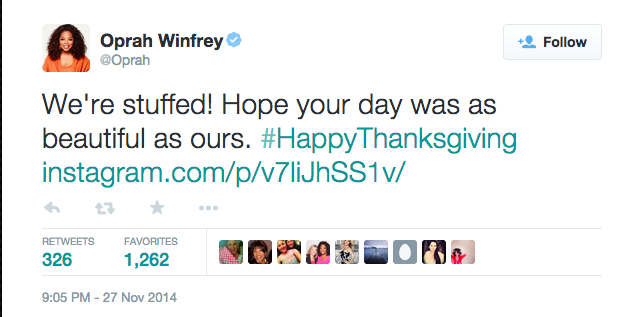
This particular scam is gaining credibility by posting images of well-known celebrities such as Oprah Winfrey and Tyler Perry endorsing the giveaway on social media. The only problem is that these images are doctored. Poorly, at that.

Cynthia Stafford Lottery Winner

Doctored endorsements from Oprah Winfrey and Ellen DeGeneres

Anyone who is familiar with Twitter should be able to spot the issue with these Photoshopped tweets. If you are not familiar with Twitter, let me help you out: There is no blue checkmark to show that the accounts are verified. The verified account system exists to prevent exactly this sort of fraud.

Besides the tweets not showing the verified account checkmark (which can easily be photoshopped), notice that both messages use extremely similar language. This is another red flag; as someone who has worked as a social media manager before, you need to try and be creative when repurposing the content of others. You would not see two major brands with such similar style.

Noticed the blue checkmark, which indicates that Twitter has manually verified this account is in fact operated with the consent of Oprah Winfrey

Noticed the blue checkmark, which indicates that Twitter has manually verified this account is in fact operated with the consent of Oprah Winfrey

Even if you don’t notice the checkmark, a simple visit to the pages of Oprah or Ellen would reveal that these tweets don’t exist. If you’re already on Twitter, it takes only a few seconds to double-check the veracity of these endorsements. Like… literally two seconds. @Oprah is six characters. It takes more keystrokes to visit Redtube and I know you aren’t complaining about how hard that is.

These scams use money to lure in followers

They also cleverly use you to spread the message and recruit others by asking you to screenshot the promotion and tag your friends. This is viral marketing at its most pure. You are spreading an erroneous message exponentially; your friends are more likely to spread it themselves because they trust the source of the message— you.

Once the account has accrued as many followers as the scam will allow, it will change its handle or its focus. Sure, it will no doubt lose many followers who realize the deception, but many, many people will simply ignore it or forget how they ended up subscribed. From there, the scammer has a captive audience much bigger and much more quickly than they could have built it organically.

Just a basic bit of education for everyone out there who doesn’t know or use these steps. I hope you’ll be a bit more critical and informed going forward!

I Just Graduated — Now What?

Cover graphic I just graduated now what

“I just graduated. Now what?” is more or less the zeitgeist of the Millennial generation. We’ve been raised since we were children to believe that a college degree held all of the answers we needed to know what we wanted to do with our lives. Many of us find out only after graduation that the degree was simply another stepping stone, not a conveyor belt. As a young college student or graduate, you need to take the steps which will lead you to where you want to go. The four-year degree track will not magically take you there. Some people realize this during college or even before; others do not see that far ahead.

So we end up with “I just graduated. Now what?”

That’s a tough question. The answer will vary hugely from person to person, depending on circumstances. The privileged white kid whose parents paid her tuition will have a different answer than the first-generation student saddled with debt. The engineer will have a different answer than the English major. The overachiever who completed a few internships and worked a side job will be in a different situation than someone who did neither of those things in order to focus on their grades.

Unless you’re lucky enough to finish college with a job offer, nonetheless you will end up lost for a moment, asking “Now what?”

My advice would be: live your life, and don’t worry too much about the money. Work to live, don’t live to work. I’m not much of anyone though. You don’t have any reason to listen to me. What’s to say that my approach won’t end in pain and misery and loneliness by age 29? Better to look to those who have proven themselves successful, Katherine Schwarzenegger says.

This is the approach Katherine Schwarzenegger (of the Schwarzeneggers) takes in her book (Anthology? Interview Collection? Curated Collection?) “I Just Graduated… Now What? — Honest Answers From Those Who Have Been There.” This book is a collection of essays written by famous figures about the path they took to success. Seems interesting enough, but unfortunately, it does not deliver on its potential. Book is dead boring and seriously lacking in insight.

Reading this book is no more helpful than asking all the adults you know how they got their jobs.

The stories contained within are random and the collection has no underlying thesis or thread. Some of the contributors never even graduated college, which seems a bit disingenuous for a book which is ostensibly about how to leverage your college education. Not that these dropouts have nothing to say— I’d actually argue that their chapters are the most focused and relevant, especially when put besides say, Serena Williams’ one-page essay which essentially says “I made sure to do other things so I’m not fucked when my tennis career ends.” Thanks, Serena.

Before we go on, I’m going to do you a favor and transcribe the entire list of contributors, as a public service for those who may be interested in the book. I have also linked to a recent relevant work by each contributor. If you are interested, you may explore many of these people and their careers further by clicking their names.

  • Laysha Ward (Target exec.)
  • Darren Hardy (Entrepreneur)
  • Alli Webb (Entrepreneur)
  • Adam Braun (Entrepreneur)
  • Maria Shriver (TV Anchor)
  • Matt Barkley (NFL Quarterback)
  • Cristina Carlino (Entrepreneur)
  • Mike Swift (Chef)
  • Serena Williams (Tennis star)
  • Arnold Schwarzenegger (Actor/ Politician)
  • Gayle King (TV anchor)
  • Candace Nelson (Entrepreneur)
  • Ron Bergum (CEO)
  • Ben Kaufman (Entrepreneur)
  • Joe Kakaty (CEO)
  • Dan Siegel (Psychiatrist)

That list is heavy on entrepreneurs and privileged people. I bolded the ones who I thought had something to say. Four out of 31 (32 if you count Katherine Schwarzenegger herself, who contributes nothing to the collection except staggering amounts of privilege) is not a very good quality ratio for anything, let alone an anthology, which by its very nature implies some degree of curation.

The huge concentration of entrepreneurs who did not pursue traditional careers paths aside, many of these essays only tell the what, not the how. It’s hard to connect with the story in the book when essayist after essayist says “I got a job at a TV station in Baltimore right after graduating” or “I saw a need and founded my company to address that need. It was hard, but in the end it was all worth it.” These stories, while true and perhaps uplifting to a certain sort of person, are utterly useless to the struggling Millennial generation. There is critically little practical advice in this book, which I feel is more or less the pitch. The practical information is shoehorned into two tiny chapters at the very end, dealing with debt and the stigma of moving back home.

There is too much privilege in this book for it to be palatable to me, and I’m a straight upper-middle class white male. This is a book written by a rich white girl who is the daughter of a Kennedy and a beloved actor who was also a highly influential politician. That perspective alone almost invalidates the book; the essayists do not do much to salvage it. I can’t imagine these essays appealing to much of my generation, especially not my peers who were sold a college degree as the catch-all answer to social advancement, by their parents and by society at large. The book really steps aside on the bigger issues inherent in the current college crisis, which is absolutely shameful. If the book isn’t going to address the question in the title or the larger societal issues inherent in that question, why bother?

Do I think too big? Maybe. Does the book live up to the title, at least in letter if not in spirit? Maybe again.

But that’s the huge elephant in the room, the heart of this issue, the unspoken challenge that is tearing an economic and idealistic hole through our underclass. Surface-level thinking and surface-level studying GETS YOU NOWHERE. Your degree is utterly worthless if you don’t dig beyond what is presented to you in school. Doing what our parents and our predecessors did will not yield the same results for our generation. The path to success leads nowhere. We need to think of that path as the trek to base camp; the real work begins when that trail ends. You can’t extend that trail with law school or graduate school; at a certain point you need to put your fears under you and start climbing. 

“You progressing on something, and that’s, that’s all about. You gotta keep moving, having a progress in your life.”

—Ueli Steck

Christopher Nolan’s “Interstellar” is less than stellar

Christopher Nolan is one of the best mainstream filmmakers working today. There are better, I won’t argue that with you, but there are only a select few artists in the mainstream who can consistently make blockbusters that are as visually pleasing, thought-provoking, and tense as those that bear the stamp of Syncopy, Christopher Nolan’s production company.

Nolan is one of the only filmmakers whose movies I will see without knowing anything about them. I went into “Interstellar” having seen a trailer or two, and not much else. I knew it was sci-fi, a genre I love, and from a man whose previous original projects included “Inception,” “Memento,” and “The Prestige.” Those are all fantastic mind-bending films which have a lot of flair. It’s hard to argue with a pedigree like that (although many online Steven Spielberg fans will argue with you about it until neither of you enjoys the discussion anymore).

Interstellar tries really hard to fit the same mold, but it just didn’t work for me in the same way Nolan’s earlier films did. Simply put: Interstellar is a decent film, but I left it in the theatre (along with eighty dollars, but that’s another story). My mind was already on tomorrow by the time the lights came up. I didn’t find myself immediately wanting to rewatch it, which is the way I felt after “Memento,” “The Prestige,” and “Inception.”

This may be because Interstellar uses less sleight-of-hand to keep audiences guessing.

Although the plot of the movie (I’ll keep it vague, promise) revolves around some fairly advanced astrophysics, information or understanding is never withheld from the audience. The critical scenes in the movie all have clearly defined stakes and rules. The movie progresses from plot point to plot point in a linear fashion. And even when the film ventures into strange territory and advanced theoretical concepts, there’s never much of a sense of mystery or wonder.

The cinematography is jaw-dropping and breaks its back to instill meaning and scale into the void left by a compelling plot. The score by Hans Zimmer is well-constructed, but unobtrusive (not usually a word I would use to describe the work of Hans Zimmer).

Matthew McConaughey as Cooper is the emotional center of the movie, and it is largely the strength of his performance that anchors the movie. Nolan clearly understood this, as he hangs the success this film on emotional appeal.

I’m a cerebral person. Although I can appreciate a good tearjerker or a quiet movie which silently swims on emotional subtext, I’ll take the guessing game of “Memento” over that stuff any day. At least in a Christopher Nolan film.

I left the theatre underwhelmed; my girlfriend came out sobbing.

I can’t say that “Interstellar” was a bad film; it clearly connected with her, and others I have spoken to about the film echo her sentiment. The film strikes a resounding emotional note. And for some people, that’s enough. Strike that note in the cold vacuum of space though, and it produces no sound.