Book Review: “Standing in the Light”

Standing in the Light Pantheist book

“Standing in the Light” by Sharman Apt Russell is a mediocre, book-length personal essay. The book is a history of pantheism told through a personal lens.

Using the braided structure popularized by creative nonfiction and personal essayists, Russell weaves back and forth between the story of her own life as a naturalistic, pantheist Quaker, and the story of pantheism and its key thinkers through the ages.

Pantheism, here defined as: “Everything is connected and the web is holy.”

Continue reading

Book Review: “California” by Jennifer Denrow (poetry)

Jennifer Denrow Poetry

My girlfriend has never been to California.

We lie awake at night, snow falling softly outside the window of our ski-town cabin. Cozy under the blankets, we stare at the flakes obscuring the bright mountain stars, and wonder about someplace else.

“California is the sort of place where it seems like anything can happen,” I tell her. “We’ll go there, someday.”

This is the sort of exchange which underlies Jennifer Denrow’s audacious book of poetry, “California.” Denrow is a young American poet from my home state of Colorado. As with all modern poetry, her work is obscure except in certain circles. I’m doing my little bit to change that.

The title poem, “California” is my favorite piece of poetry.

“California” is broken up into three sections. The first is a long poem titled “California.” This is the gem of the book. The second section consists of more traditional, shorter verses. This section, like many poetry collections, is rather hit-or-miss. The third section consists of a back-and-forth dialogue between ventriloquist Edgar Bergen and his dummy, Charlie. This section struck me as too avant-garde. Perhaps I lacked the proper context to understand the subtext of this section, but it never clicked for me. It doesn’t matter though.

Section 1, the “California” poem, is worth the price of admission alone.

“California” is a poem about escapism and the lingering dissatisfaction of modern life. The opening lines of the poem state this mission well enough:

“Forget Your life
Okay, I have
Lay down something that is unlike it
Sold boat, Italian song”

The poem goes on for 19 pages, and it continues to expand beautifully and elliptically on the abstract idea of California as a stand-in for satisfaction, exotica, and adventure in our everyday lives, which find themselves dulling more and more as computer slowly remove the very essence of living from many situations.

I won’t transcribe the whole thing here, because Denrow is a young poet who very much deserves your money. I encountered this book during an advanced undergraduate course I took, “E 479: Modern American Poetry.” The class was taught by Dan Beachy-Quick, himself a successful modern American poet. Beachy-Quick is the closest thing you’ll encounter to a genius at a state university, and I’ll always hold a respect for the man. His rambling nature of speaking made going to class every day absolutely worth it, just to hear the strange tangents he could touch on and still leave you with something of value.  He told us to go buy a random book of modern poetry off of Amazon, because the library wouldn’t have anything and the authors appreciated every purchase they could get.

Live Your Passion: Dan Beachy-Quick from Colorado State University on Vimeo.

So I’ll repeat this man’s great message: buy Denrow’s book. Both of you and she will appreciate it.

The book is melancholy, looking inward and outward simultaneously as it explores the concept of leaving. “California” tiptoes past suicide, depression, and the spectre of a rapidly receding youth with gorgeous, deadly quiet lines.

I’ve written academic criticism on the poem, but that defeats the point, really. Read it yourself, and then think on it for a few days. Think about California.

California Jennifer Denrow Poetry

Then go.

(If you’d like to purchase the book, you can throw TWO poor writers a bone by buying it through my Amazon affiliate link)

Book Review: “The Four Agreements”

Toltec Wisdom Book

My father gave me “The Four Agreements” by Don Miguel Ruiz for my birthday. My father is one of the most evenhanded people I know: he rarely gets angry, loses his composure, or even raises his voice. He practices Tai Chi twice a week. He’s pragmatic. He lives a simple life, not full of overmuch excitement, but also not full of any reversals of his good fortune.

I have learned a lot in recent years from my father. Once I decided to start paying attention, I found a lot of myself in him. Not an uncommon situation, I don’t think.

Right on the cover, “The Four Agreements” proclaims itself as a “practical guide to personal freedom.” Not many people are very free in today’s world. Whether its their iPhone, their spouse, their lack of funds, their anxiety, or their crippling fear of missing out, almost everyone I get to know has a laundry list of issues and neuroses which seem to interfere with their lives. I have my own, of course.

I run a blog called “This is youth.” I have a staked interest in making myself as free as possible.

I read “The Four Agreements” in one day. It is a short book, 140 pages double-spaced. The tone is conversational. The pages fly. This book is worth your day.
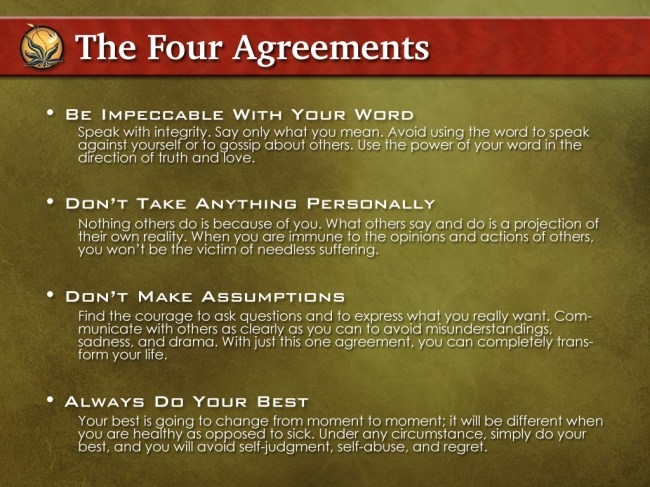
(But if you're too lazy, here's the basic Toltec thesis for a good life)

(But if you’re too lazy, here’s the basic Toltec thesis for a good life)

“The Four Agreements” puts forth a framework for experiencing the world based on ancient Toltec teachings. The philosophy of the book reminded me of Zen, in the way it advocates flowing with the world and letting go of resistances and ties to the past. These four Agreements in the text essentially recommend stripping away as much of the societal framework from your thinking as possible. It is not stated directly as such, but it’s hard to imagine the Toltec approving the way thousands of little ties with which we restrain ourselves every day.

Grudges, assumptions, personal feelings, what-if scenarios. These are all black situations which Don Miguel Ruiz advises you to leave behind. He encourages readers to embrace every moment of life anew, the way a child does.

While this line of argument may seem naïve and impossible, I challenge you to think about your own life. Things are usually best when we are fully in the moment, not preoccupied, not judging, not answering work e-mails on our smartphones. It is a difficult concept to consider, but really, why can’t we live our lives that way all of the time?

It may be idealistic, but hey. This is youth.

The problems with “Pledged: The Secret Life of Sororities”

Pledged

Here’s a fun fact about fraternities and sororities:

all of the stereotypes are true.

Here’s a fun fact about my life:

I founded a multicultural fraternity my freshman year of college.

Here’s how those two fun facts fit together:

although the stereotypes may be true, they don’t come close to giving you a complete picture of what Greek life is like for those who live it. And these stereotypes serve as a crutch for people who are not willing to understand the complex relationships which drive Greek organizations. This is the real issue I have with Alexandra Robbins’ “Pledged: The Secret Life of Sororities,” a decade-old expose of Greek Life which I just finished reading. It does not live up to the promise of the title. The book has no secrets to share. “Pledged: The Secret Life of Sororities” simply regurgitates the common cultural narrative, without trying to unpack why it is that narrative holds such pull. “Pledged” is cheap.

Continue reading