
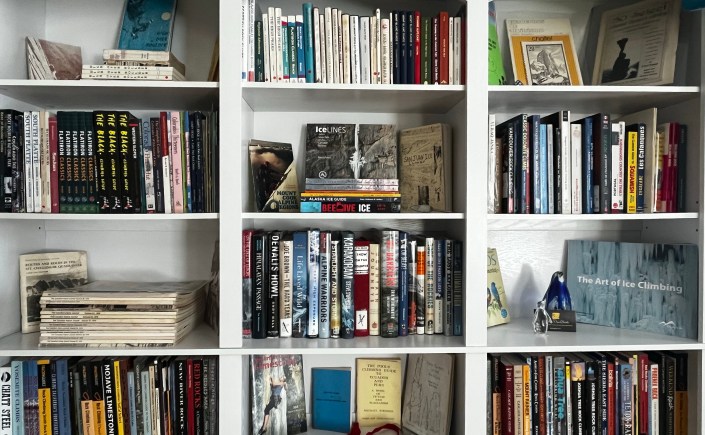
My online store selling climbing guidebooks and mountaineering literature has really taken off. I just passed my 100th online order at Dirtbag Dan Books, accounting for over 500 books sold! This has been an engaging and exciting project. It has also been bringing all sorts of interesting climbing books to my door. I’ve been trying to read the ones which interest me quickly, in case they sell.
Mountaineering literature is a specific genre, but broader than you might think. Here’s what I’ve been into lately:
The Eiger Sanction by Trevanian
A spy novel with a climbing setting. This book is ridiculous—over-the-top in a way that rides the line between being obvious satire and campy tribute to the spy-thriller genre. Amidst all the depressing climbing biography and memoirs — grim grey tales tending to be filled with struggle and death — this was a bright splash of color. Indeed, the first-edition hardcover I read has a striking, bright pink cover.
The plot involves a retired climber being hired as a hitman to kill a member of his climbing party while they make an attempt on the North Face of the Eiger. The only issue: he doesn’t know which of his three climbing partners is his target.
Trevanian gets the details of the climbing right, both technically, geographically, and emotionally. But more than that, the story moves on at a jaunty pace, and has fun doing so. They made a movie out of this book starring Clint Eastwood.
You can buy it from Amazon, since I’m not parting with my copy.
I also read the sequel, The Loo Sanction, which was not as good. Maybe a little too on-the-nose, since the plot revolves around a secret retreat where Britain’s elite go to indulge their most depraved, illegal, and immoral sexual fantasies, and are recorded and blackmailed with their involvement.
Against the Wind by Reinhold Messner (2025)
Absolutely awful book. Shockingly bad. Worst one I’ve read in some time. I would have walked away if I didn’t feel a professional obligation to see it through to the end. The only redeeming words I can offer are that the chapters are short, and thus it reads quick.
Reinhold Messner is one of the most famous mountaineers of all time. Maybe the most famous. Despite his stellar climbing record (first to climb all 14 8,000-meter peaks, numerous new routes on big mountains across the world), he has always been a controversial figure. This book revisits all the controversies, big and small, throughout Reinhold’s life. But it doesn’t offer any new perspective from the wisdom of age (Messner is now 81) — this book just offers stubbornness and superiority. All it has to say is: “I was right.”
I actually lost respect for Messner after reading this book.
Straight Up by James Ramsey Ullman
A pretty dang good biography of American alpinist John Harlin II, who was killed during the first ascent of the Eiger Direct when a fixed line he was ascending snapped, and he fell to the base of the Eiger North Face.
Ramsey Ullman has a knack for good prose, and Harlin himself cuts a striking central figure. I found myself about 150 pages into this book and realized that the main figure had hardly done any climbing at all. That was delightful, to learn more of the personality and inner workings of a man, instead of reading a rote list of ascents and climbing partners.
Although you know how the story ends from the start, like a classical tragedy, you begin to build empathy and attachment to the hero as the story goes. So when Harlin’s rope finally snaps, you as the reader can understand exactly what Layton Kor felt when he stood over Harlin’s body and wept at the base of the Eiger.
I enjoyed this one a lot, and thus have placed a higher price on it. You can buy it from me for $20.
Beyond the Vertical by Layton Kor

It’s interesting how one book leads into another in the climbing world. Layton Kor, Royal Robbins, and John Harlin all played parts in each other’s stories. It makes sense when you know climbing – the best players will want to meet up, feel each other out, and if they can make a strong partnership, write new lines into the history books.
But it doesn’t always work out that way. Kor, in a later article written by Ed Webster, said that he felt he and Harlin were soul brothers, and had made great plans for the future. Those plans never happened; Harlin fell, and just a few years later, Kor completed his final serious climb, the Salathe Wall on El Capitan with Galen Rowell. A year later, he became a Jehovah’s witness, and faded quietly into the background of climbing history, remaining only as a name and a legend.
This book was published in 1983, at a time when Kor had been out of the spotlight for a while. The editor of the book, Bob Godfrey, describes having to pull the project out of Kor — although Kor was more than happy to recount old climbing stories at the dinner table, as are most of us.
So although this book bears Layton Kor’s name as the author, it is really more of a Bob Godfrey book, the story of Kor’s climbing career stitched together through Kor’s narration, beautiful full-page photos, and essays contributed by his climbing partners on significant ascents.
Nonetheless, one can gain a good sense of who Layton Kor was through this book, and the coffee-table format makes the pictures really pop. Not a book which needs to be read all the way through at once, but one which can be savored over the course of a couple months, a chapter at a time.
I’ll sell you a beautiful first-edition hardcover Beyond the Vertical for $35.
Royal Robbins: The American Climber by David Smart
If you were a climber in Colorado in the 1960s, you’d think of Layton Kor as ‘the man’. If you were a climber in California, you may have had the same feelings about Royal Robbins. Robbins wrote a beautiful biography on the walls of Yosemite in the 1960s and 1970s, with many first ascents and an unofficial role as the moral leader of the Yosemite climbing scene. Still, my image of the man has always been a little “Boy Scout.” I thought I owed it to get a fuller picture of this most famous of American Climbers.
Since I sold my Pat Ament biography of Robbins, “Hero of the Age,” I had to make do with this more contemporary one by David Smart, titled “The American Climber.” This was released in 2023, and suffers from being published after Robbins’ death, making it a little matter-of-fact.
Smart’s prose is clear and inviting, and rolls you along the path of Robbins life smoothly. Maybe a little too smoothly, as it seems only when we approach the very end of Royal’s life do we start to get some emotional subtext. This is likely due to the fact that Smart worked tightly with Tamara Robbins, Royal’s daughter, who would have been able to contribute a little more firsthand context and perspective to Royal’s later years. Unfortunately, this leaves the bulk of Royal’s climbing years as far-off, calcified by the crust of legend, death, and tact.
Smart knows the difficulty he faced: the author’s note at the end is titled: “A Remote, Hard-to-Fathom Figure.” Although the quote came from Chris Jones, author of Climbing in North America, it remains apt, even after reading all of The American Climber.
In the end, this is a serviceable book, superbly researched and written in a friendly, approachable manner; but it does not find the center of Royal. Indeed, only in the epilogue does that become clear. Here, Smart quotes from Robbins’ journal:
“One is never hard at the center,” Royal wrote in his notebooks, bringing us closest to the source of his being. “At the center is that little boy, open and flower-like, who screams to be listened to, who cries to escape, to be let out, to not be so deeply imprisoned, who would prefer to submit before God, yet is forced by the repeated blows of life to retire deeper, safer from the wounds, to retire so deep and so safe that he appears to not be there at all.”
The Royal Robbins depicted in this biography is deep and safe, and despite the 230 pages describing his life, at the end of the book, he barely seems as if he has been there at all.
The Daily Stoic by Ryan Holiday
This book came to me as part of a massive collection I bought from old-time Colorado climber Steve Komito. I went to Steve’s house in Estes Park where he’d lived for 50 years, packed my minivan full to the gills with his climbing books and magazines, and hit the road. Steve sold his house a few days later, and headed to assisted living.
This was one of very few modern books in the collection – most were (literally or figuratively) dusty tomes from the 60s and 70s. This book was really in the zeitgeist about six years ago; so I’m behind the curve. Steve was probably right on it, and has moved on to the new trendy philosophy (I’ll have to ask him what he’s reading when I see him next.)
The real genius of this book is in the format. It’s called the “Daily” Stoic because it’s designed to be read habitually. Each day of the year has one quotation from an ancient stoic philosopher, and then a few paragraphs discussing how we can apply that thought to our daily lives. The quotations are arranged by theme; each month explores a larger idea, such as presence, death, or acceptance.
Put the book on your coffee table and it will call out to you with more success than most philosophy books. After all, you almost always have time to read a page or two.
I’ll keep working through Steve’s copy, so if you’re interested, you can buy the Daily Stoic on Amazon.
What’s Up Next?
Maybe something non-climbing related? A little lighter and easier?
I have been contemplating a re-read of The Brothers Karamazov. This book is a masterpiece, and I am sure it would reveal different layers to an older Daniel.
Or it’s the 30th anniversary of Infinite Jest… they are releasing a new edition…? Also a masterpiece, this book was extremely prescient in predicting a world where we would be distracted from the real, hard work of mindful living by technology which would allow us to entertain ourselves to death. It’s become a bit of a punching bag, a shorthand for calling someone pretentious – but this book deserves the hype and is worth the work it takes to read. That said, it is a lot of work… you need three bookmarks.
Back to climbing. I’ve heard a lot of good things about Red Rock pioneer Joanne Urioste’s new autobiography. And it would be nice to read about a female climber, after all the testosterone in this list. But boy is it hard to pay full price for a mountaineering book when I have so many hundreds unread in my house.
We’ll see. The good news is I have been reading a lot; and reading a lot tends to invite further reading & writing. So hopefully you’ll hear from me a little more frequently on this blog, now that the bookstore is up and running.
Cheers.

