“Eiger Dreams: Ventures Among Men and Mountains” was first published in 1990. Well before the cultural zeitgeist embraced the outdoors as the hippest, healthiest place to play, and long before #adventure became chic, Krakauer began his book with this epigraph:
“Having an adventure shows that someone is incompetent, that something has gone wrong. An adventure is interesting enough in retrospect, especially to the person who didn’t have it; at the time it happens it usually constitutes an exceedingly disagreeable experience.”
There’s something to be said here about the wisdom of your elders, but considering the name of this website, I’ll leave it hanging.
A collection of climbing and mountaineering essays and articles written for Outside Magazine and others, “Eiger Dreams” was the first book ever released by author Jon Krakauer, who would later go on to find literary fame with two heavy hitters: “Into The Wild” and “Into Thin Air.” By nature of being an essay collection, “Eiger Dreams” doesn’t demonstrate the thematic and narrative tightness of those later books; some essays are worth reading, others will likely have you skipping ahead to see how much longer until the next one.
We lie awake at night, snow falling softly outside the window of our ski-town cabin. Cozy under the blankets, we stare at the flakes obscuring the bright mountain stars, and wonder about someplace else.
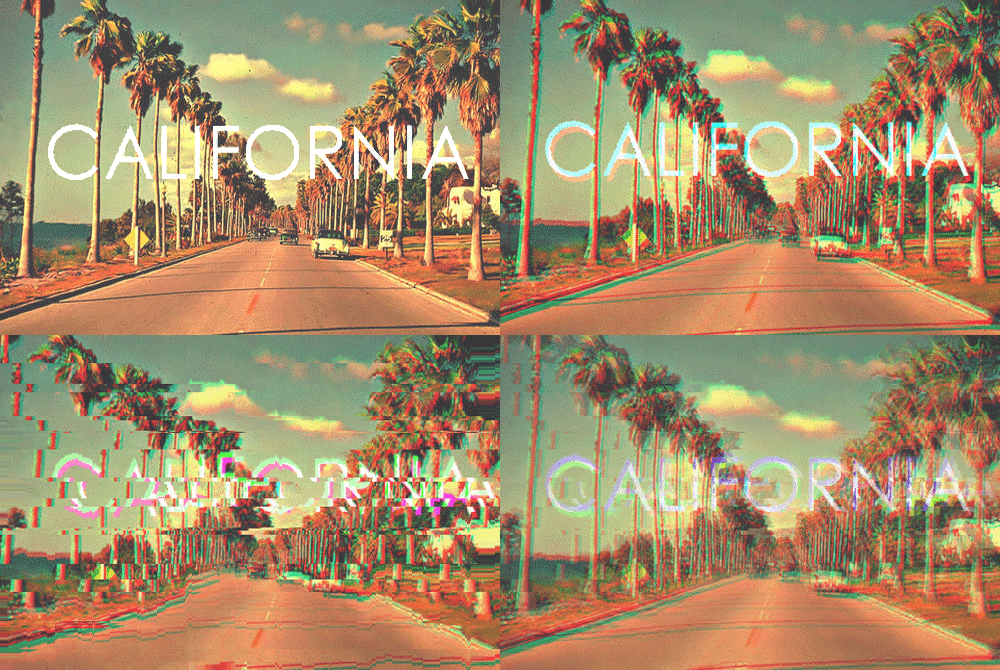
“California is the sort of place where it seems like anything can happen,” I tell her. “We’ll go there, someday.”
This is the sort of exchange which underlies Jennifer Denrow’s audacious book of poetry, “California.” Denrow is a young American poet from my home state of Colorado. As with all modern poetry, her work is obscure except in certain circles. I’m doing my little bit to change that.
The title poem, “California” is my favorite piece of poetry.
“California” is broken up into three sections. The first is a long poem titled “California.” This is the gem of the book. The second section consists of more traditional, shorter verses. This section, like many poetry collections, is rather hit-or-miss. The third section consists of a back-and-forth dialogue between ventriloquist Edgar Bergen and his dummy, Charlie. This section struck me as too avant-garde. Perhaps I lacked the proper context to understand the subtext of this section, but it never clicked for me. It doesn’t matter though.
Section 1, the “California” poem, is worth the price of admission alone.
“California” is a poem about escapism and the lingering dissatisfaction of modern life. The opening lines of the poem state this mission well enough:
“Forget Your life
Okay, I have
Lay down something that is unlike it
Sold boat, Italian song”
The poem goes on for 19 pages, and it continues to expand beautifully and elliptically on the abstract idea of California as a stand-in for satisfaction, exotica, and adventure in our everyday lives, which find themselves dulling more and more as computer slowly remove the very essence of living from many situations.
So I’ll repeat this man’s great message: buy Denrow’s book. Both of you and she will appreciate it.
The book is melancholy, looking inward and outward simultaneously as it explores the concept of leaving. “California” tiptoes past suicide, depression, and the spectre of a rapidly receding youth with gorgeous, deadly quiet lines.
I’ve written academic criticism on the poem, but that defeats the point, really. Read it yourself, and then think on it for a few days. Think about California.
Then go.
(If you’d like to purchase the book, you can throw TWO poor writers a bone by buying it through my Amazon affiliate link)
“I just graduated. Now what?” is more or less the zeitgeist of the Millennial generation. We’ve been raised since we were children to believe that a college degree held all of the answers we needed to know what we wanted to do with our lives. Many of us find out only after graduation that the degree was simply another stepping stone, not a conveyor belt. As a young college student or graduate, you need to take the steps which will lead you to where you want to go. The four-year degree track will not magically take you there. Some people realize this during college or even before; others do not see that far ahead.
So we end up with “I just graduated. Now what?”
That’s a tough question. The answer will vary hugely from person to person, depending on circumstances. The privileged white kid whose parents paid her tuition will have a different answer than the first-generation student saddled with debt. The engineer will have a different answer than the English major. The overachiever who completed a few internships and worked a side job will be in a different situation than someone who did neither of those things in order to focus on their grades.
Unless you’re lucky enough to finish college with a job offer, nonetheless you will end up lost for a moment, asking “Now what?”
My advice would be: live your life, and don’t worry too much about the money. Work to live, don’t live to work. I’m not much of anyone though. You don’t have any reason to listen to me. What’s to say that my approach won’t end in pain and misery and loneliness by age 29? Better to look to those who have proven themselves successful, Katherine Schwarzenegger says.
This is the approach Katherine Schwarzenegger (of the Schwarzeneggers) takes in her book (Anthology? Interview Collection? Curated Collection?) “I Just Graduated… Now What? — Honest Answers From Those Who Have Been There.” This book is a collection of essays written by famous figures about the path they took to success. Seems interesting enough, but unfortunately, it does not deliver on its potential. Book is dead boring and seriously lacking in insight.
Reading this book is no more helpful than asking all the adults you know how they got their jobs.
The stories contained within are random and the collection has no underlying thesis or thread. Some of the contributors never even graduated college, which seems a bit disingenuous for a book which is ostensibly about how to leverage your college education. Not that these dropouts have nothing to say— I’d actually argue that their chapters are the most focused and relevant, especially when put besides say, Serena Williams’ one-page essay which essentially says “I made sure to do other things so I’m not fucked when my tennis career ends.” Thanks, Serena.
Before we go on, I’m going to do you a favor and transcribe the entire list of contributors, as a public service for those who may be interested in the book. I have also linked to a recent relevant work by each contributor. If you are interested, you may explore many of these people and their careers further by clicking their names.
That list is heavy on entrepreneurs and privileged people. I bolded the ones who I thought had something to say. Four out of 31 (32 if you count Katherine Schwarzenegger herself, who contributes nothing to the collection except staggering amounts of privilege) is not a very good quality ratio for anything, let alone an anthology, which by its very nature implies some degree of curation.
The huge concentration of entrepreneurs who did not pursue traditional careers paths aside, many of these essays only tell the what, not the how. It’s hard to connect with the story in the book when essayist after essayist says “I got a job at a TV station in Baltimore right after graduating” or “I saw a need and founded my company to address that need. It was hard, but in the end it was all worth it.” These stories, while true and perhaps uplifting to a certain sort of person, are utterly useless to the struggling Millennial generation. There is critically little practical advice in this book, which I feel is more or less the pitch. The practical information is shoehorned into two tiny chapters at the very end, dealing with debt and the stigma of moving back home.
There is too much privilege in this book for it to be palatable to me, and I’m a straight upper-middle class white male. This is a book written by a rich white girl who is the daughter of a Kennedy and a beloved actor who was also a highly influential politician. That perspective alone almost invalidates the book; the essayists do not do much to salvage it. I can’t imagine these essays appealing to much of my generation, especially not my peers who were sold a college degree as the catch-all answer to social advancement, by their parents and by society at large. The book really steps aside on the bigger issues inherent in the current college crisis, which is absolutely shameful. If the book isn’t going to address the question in the title or the larger societal issues inherent in that question, why bother?
Do I think too big? Maybe. Does the book live up to the title, at least in letter if not in spirit? Maybe again.
But that’s the huge elephant in the room, the heart of this issue, the unspoken challenge that is tearing an economic and idealistic hole through our underclass. Surface-level thinking and surface-level studying GETS YOU NOWHERE. Your degree is utterly worthless if you don’t dig beyond what is presented to you in school. Doing what our parents and our predecessors did will not yield the same results for our generation. The path to success leads nowhere. We need to think of that path as the trek to base camp; the real work begins when that trail ends. You can’t extend that trail with law school or graduate school; at a certain point you need to put your fears under you and start climbing.
“You progressing on something, and that’s, that’s all about. You gotta keep moving, having a progress in your life.”



 thisisyouth