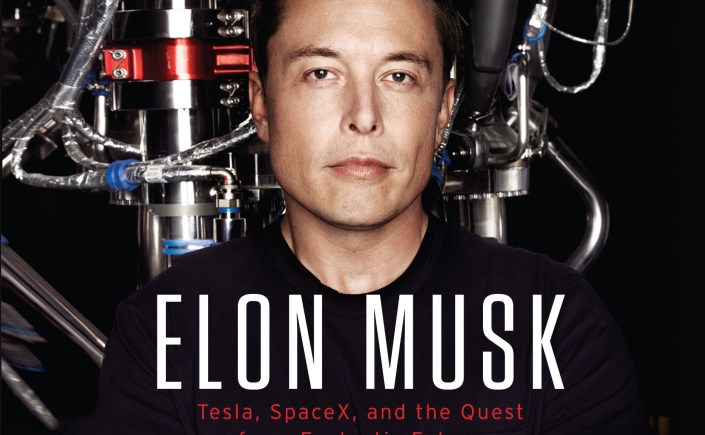
Elon Musk is the single most influential figure alive today.
I don’t hesitate to say that, not one bit.
In only 44 years on this planet, Elon Musk has been involved with five consistently cutting-edge companies: Zip2 (early Internet mapping), PayPal (Early Internet banking), Tesla (modern electric cars), SpaceX (cheap, reusable rockets), and SolarCity (solar power).
Every single one of those sectors has changed the world, or will change the world. Musk is a man who has changed the world in five COMPLETELY DIFFERENT sectors. His efforts will eventually lead towards an emissions-free world, and eventually, a new world altogether.
I bought Jennifer Egan’s “A Visit From the Goon Squad” for $1 at a yard sale. The sorority girl who had been the previous owner, apparently, had not deigned it worth bringing home.
Her loss.
“A Visit From the Goon Squad” released in 2010, and eventually won the Pulitzer Prize for literature. The book follows a loosely connected group of characters, jumping through time and place in order to tell a larger story about the arcs of our lives.
INVARIABLY, these are the words which follow the revelation that you are an English major. There is literally no other response. Society has no use for English majors other than to teach new English majors, it seems.
This line of thinking is outdated, and wrong.
The rise of the Internet economy has created an entirely new use for those graduating college with liberal arts degrees. English, Communications, Journalism, and similar majors are suddenly in high demand. Why?
Because everything on the Internet is written by English majors.
I bought this book as a Christmas present for my girlfriend, entirely on a whim and with no more context than a few Amazon reviews. I did not realize that it would read very much like the sort of book I might write in ten years.
Leonard draws his inspiration from climbing, mountaineering, skiing and seeing the world through a lowly lens. His book chronicles a post-breakup period of dirtbagging around America in the back of a Subaru Outback. He even starts his odyssey in Denver. The similarity to my own sensibilities was simultaneously comforting and disconcerting.
The book is a quick read— I read the entire thing in the span of a few hours.
It is even printed double-spaced, like an assignment you would turn in for your writing class. It was self-published, which fits the ethos of the writing. The copyright page contains five lines. All that blank space is exciting.
“The New American Road Trip Mixtape” is adventure writing— quick, breezy and inspirational. To the sort of person who can identify with Leonard’s passions, the book will practically read itself. Those who can’t appreciate the appeal of the modern dirtbag lifestyle won’t find much of substance here.
It’s telling that two months since Christmas, I am the first one in the household to finish this book.
“The New American Road Trip Mixtape” differs from the writing I give you here in one key way. “The New American Road Trip Mixtape” is not a celebration of youth, but rather a chronicle of the end of youth. The book is about Leonard’s pivot into a deeper understanding of the world, not simply a celebration of living. The story is very much that of an inflection point in life.
“What is a life?”
This phrase is repeated often throughout the book. The full question, “what is a good life?” goes largely elided and unanswered. In the final pages of the book, Leonard sums it up as well as he can:
“There was something in everyone I knew in Utah, Montana, Washington, Oregon, and California figuring it out as they went, stubbing their toes and tripping sometimes, turning around after false starts and making the second or third try really count, making it as forever as we know how anymore.”
In the end, Leonard is quintessentially young, even as he chronicles his search for the way to age gracefully.
Dedicated readers will notice I updated the tagline in the banner.
“Ski town philosophy” is a much more apt summation of the blog these days. Something about the unchecked youth and recklessness pulsing around me makes me spiral into my head, and continuously think about the deeper things. When I’m not skiing or snowboarding, that is. Those activities remain, deeply, blissfully, entrancing. Outside of those hours, things make a little less sense.
I am more or less exclusively reading philosophy these days.
According to Watts, we should stop conceiving ourselves as “other,” an instead see ourselves as a part of the fabric of everything. To put the book’s thesis simply, an in-group can only exist by defining itself in terms of an out-group, thus, there is in fact no separation, and both groups are one and the same.
Watts’ rhetoric is surprisingly approachable, considering the topics he is touching upon. He flirts with Sausserian semiology at points, but his prose never becomes too dense, academic or unintelligible. I do think a basic understanding of semiology and semiotics (thanks English degree!) would provide helpful context for this book, but I wouldn’t say it’s necessary.
Watts writes well, and lays the groundwork for a lot of challenging thinking.
One can’t spend much time learning about Alan Watts without encountering his connection to the Beat Generation. Watts, an early Western evangelist of Buddhism, served as a forefather and guiding figure for young beat generation figures such as Jack Kerouac and Alan Ginsberg.
The beat generation and the millennial generation are kindred spirits, although the technological abstraction of our modern day keeps the two from being brothers. You could accurately characterize the two as like-minded cousins, perhaps.
The millennial chases “experience” and “life” above all. Raised in suburbs and by televisions, video games, and the Internet, ours is a generation with a vague sense of unease and rebellion. We don’t know what we want.
To put it in the parlance of the video above, we have a sense that the goal society has presented us with is a hoax, but we have no idea how to dance along with the music of our lives. Dancing to the music of life is where the beat generation excelled. These crazed bums knew a thing or two about how to live— or so it appears, half a century down the road. We must keep in mind what Jack Kerouac wrote in “On The Road”:
“I had nothing to offer anybody except my own confusion.”
From there, we must also understand that Kerouac died, angry and bitter, at the age of 47 due to cirrhosis of the liver. His days were spent slurring drunk, ecstatic in his escapism. Neal Cassady, Kerouac’s inspiration for the character of Dean Moriarty in “On the Road,” died at 42. Shortly before he died, he said:
“Twenty years of fast living – there’s just not much left, and my kids are all screwed up. Don’t do what I have done.”
The Beats, partially drawing their inspiration from Watts’ Buddhism and cohesive theory of existence, sought to live their lives like music. While Watts would argue that the Beat interpretation of Buddhism was somewhat different than his own, the Beats were drawn to Buddhism because they could not find the answers they wanted within their own culture.
“But the Westerner who is attracted by Zen and who would understand it deeply must have one indispensable qualification: he must understand his own culture so thoroughly that he is no longer swayed by its premises unconsciously.”
Today’s millennials do not understand our own culture thoroughly enough. We are constantly swayed by corporations, conglomerates, and social media, trends which erode our idealism and cut away at our individualism, while seemingly promoting a culture of total acceptance.
Without the awareness of the forces, micro and macro, that act on us on an everyday basis, we cannot find our youth. We will be doomed to an indescribable malaise, a nagging sense of something wrong, something unfulfilled.
“The Book” is a good place to start on that journey of understanding.



 thisisyouth