Early Season Skiing — Opening Day at Breck 2014

Arapahoe Basin vista

Things were looking a little scary there for Colorado’s ski season. A week into November, we had yet to receive any serious snow in the high country. Breckenridge Ski Resort pushed back their opening day indefinitely; skiers slipped and slid over artificial ice at Arapahoe Basin and Keystone, but no one looked like they were having much fun.

And then last week, three storms hit in such close succession that they may as well have been one week-long snowstorm. The mountains got drenched in powder; my arms got tired from shoveling so much snow; and ski season was officially upon us.

You can’t ask for a much better opening day than Breckenridge got in 2014.

I took a half day to go hit up the festivities— the storm pounding on Vail Pass didn’t provide me with much more opportunity. Vail Pass is a fairly gradual and well-engineered mountain road through the Gore Range, but it can still be quite dicey during a storm. Best to avoid traveling it, even for skiing.

Note that I say best to avoid it, not required.

This picture will NEVER stop being funny

Best picture of the Moab trip, for sure.

I bravely soared over the pass in the quintessential Colorado car, my Subaru Outback. I don’t fully trust this car— I’m pretty sure I purchased it from a recovering heroin addict, and the last time I took it on a major trip, it died about 20 miles into Arches National Park. But this was OPENING DAY, and I’d been itching to get some turns in.

It was well worth the 40-minute trip, and the pass turned out to be pretty OK. The Subaru pulled through. Maybe I just shouldn’t take it out of CO; it’s very comfortable in its natural habitat.

Breck was surprisingly empty for opening day, with plenty of room on the one run which was open. The brand-new Colorado Superchair was the only lift operating on Friday. There were mixed reviews among my fellow liftees as to the new “magic carpet” at the base of the chair, a high-tech conveyor belt which moves skiiers a grand total of about five feet, before letting them come to a stop and get picked up by the lift. “Designed by some MIT grad,” said one older snowboarder. “Probably looked great as a blueprint, just gonna cause more trouble.”

Top of the Colorado Superchair lift at Breckenridge Ski Resort

I was too busy hitting the slopes to wait for this guy’s butt to get out of my picture

The Colorado Superchair itself worked wonderfully, providing high-speed access to the middle of Breck’s Peak 8. We got nailed in the face by several gun blowing snow on the ride up, but that’s the price you pay to ski opening day. The resort did open several more chairlifts as the weekend progressed, as mother nature decided to make the snowmakers unnecessary. In fact, the ski patrol even opened some new runs around 1:30 p.m., which allowed me to get off the ice-packed main run and carve up some powder, which certainly made the trip more worthwhile.

Overall conditions were good and the atmosphere was sunny. A storm rolled in just as I was leaving, which ended up dumping another foot of snow on the mountain, which would have been awesome to play in had I not needed to traverse a mountain pass to get home.

***

Not feeling quite satiated with three hours of shredding, I headed to Arapahoe Basin on Sunday with my girlfriend; a Vail Resorts employee who was blacked out at the other resorts. (Although working for a ski resort will earn you a free season pass, you can be subject to blackouts at the resort’s discretion, sometimes without any real notice. Bummer.)

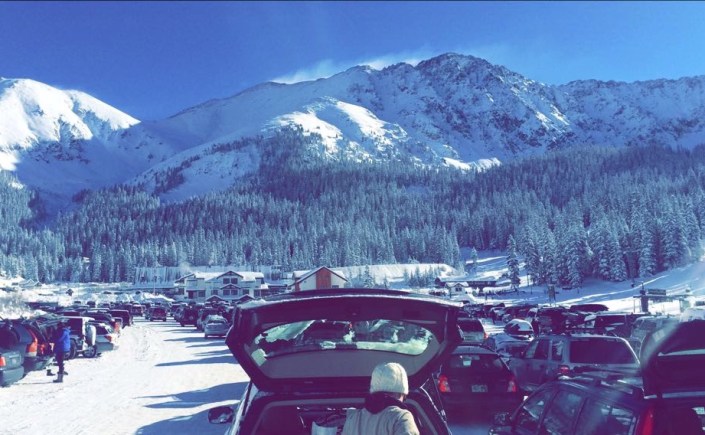
This was a weekend of questionable decision-making for questionable quality of skiing. We again traversed Vail Pass early in the morning, fought icy roads and heavy traffic near Keystone Ski Resort, before heading up the backside of Loveland Pass to reach the A-Basin parking lot, where the skies were a fierce blue and the temperatures below zero.

It was magnificent.
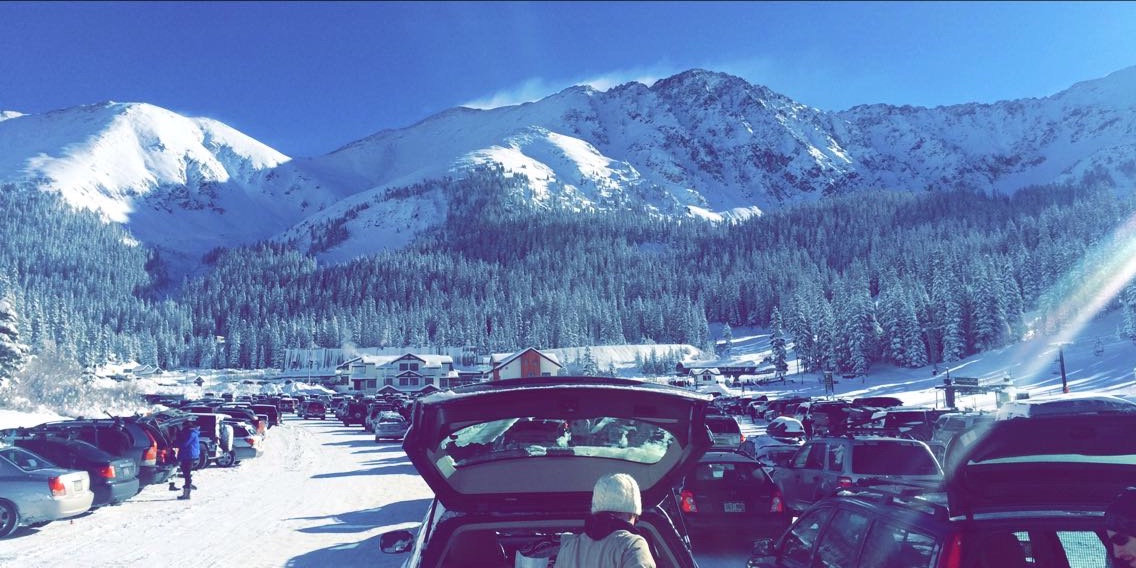
Arapahoe Basin vista

It’s hard to beat A-Basin for views// Luckily the Subaru is functioning here

A-Basin has much more of a fun feel to it than a big ski resort like Vail or Breckenridge. A-Basin is

Pow was there, tempting but off-limits.

Pow was there, tempting but off-limits.

actually a ski area, not a resort. (The difference is that a ski resort has lodging at the bottom or on the mountain, a ski area just has a parking lot).

Tourists don’t come to A-Basin. Although a Vail Resorts Epic Pass will get you entrance to Arapahoe Basin, this fact isn’t advertised very well, and Vail’s EpicMix technology, which gamifies your time on the mountain (and is actually pretty cool), does not work here. Arapahoe Basin is usually the first mountain in CO to open, and the last to close. Skiing for skiing’s sake is very much alive here.

Selfie game was NOT on point. Probably something to do with the zero-degree temperature

Selfie game was NOT on point. Probably something to do with the zero-degree temperature

Unfortunately, the snow was not. We met an old friend of mine at the base, who informed us that he thought he needed to get his board waxed. Terrain was icy and very early-season on Sunday, despite the several feet of snow that had fallen over the weekend. Freezing temperatures and the high winds inherent with the mountain pass location combined to eliminate some of the great fortune which Mother Nature had blessed us with. However, we still had a great time, logging another solid half day before responsibilities came calling.

All in all it was a great way to get my legs under me before Vail opens this Friday. Look for a condition report on Friday afternoon or evening.

I Just Graduated — Now What?

Cover graphic I just graduated now what

“I just graduated. Now what?” is more or less the zeitgeist of the Millennial generation. We’ve been raised since we were children to believe that a college degree held all of the answers we needed to know what we wanted to do with our lives. Many of us find out only after graduation that the degree was simply another stepping stone, not a conveyor belt. As a young college student or graduate, you need to take the steps which will lead you to where you want to go. The four-year degree track will not magically take you there. Some people realize this during college or even before; others do not see that far ahead.

So we end up with “I just graduated. Now what?”

That’s a tough question. The answer will vary hugely from person to person, depending on circumstances. The privileged white kid whose parents paid her tuition will have a different answer than the first-generation student saddled with debt. The engineer will have a different answer than the English major. The overachiever who completed a few internships and worked a side job will be in a different situation than someone who did neither of those things in order to focus on their grades.

Unless you’re lucky enough to finish college with a job offer, nonetheless you will end up lost for a moment, asking “Now what?”

My advice would be: live your life, and don’t worry too much about the money. Work to live, don’t live to work. I’m not much of anyone though. You don’t have any reason to listen to me. What’s to say that my approach won’t end in pain and misery and loneliness by age 29? Better to look to those who have proven themselves successful, Katherine Schwarzenegger says.

This is the approach Katherine Schwarzenegger (of the Schwarzeneggers) takes in her book (Anthology? Interview Collection? Curated Collection?) “I Just Graduated… Now What? — Honest Answers From Those Who Have Been There.” This book is a collection of essays written by famous figures about the path they took to success. Seems interesting enough, but unfortunately, it does not deliver on its potential. Book is dead boring and seriously lacking in insight.

Reading this book is no more helpful than asking all the adults you know how they got their jobs.

The stories contained within are random and the collection has no underlying thesis or thread. Some of the contributors never even graduated college, which seems a bit disingenuous for a book which is ostensibly about how to leverage your college education. Not that these dropouts have nothing to say— I’d actually argue that their chapters are the most focused and relevant, especially when put besides say, Serena Williams’ one-page essay which essentially says “I made sure to do other things so I’m not fucked when my tennis career ends.” Thanks, Serena.

Before we go on, I’m going to do you a favor and transcribe the entire list of contributors, as a public service for those who may be interested in the book. I have also linked to a recent relevant work by each contributor. If you are interested, you may explore many of these people and their careers further by clicking their names.

  • Laysha Ward (Target exec.)
  • Darren Hardy (Entrepreneur)
  • Alli Webb (Entrepreneur)
  • Adam Braun (Entrepreneur)
  • Maria Shriver (TV Anchor)
  • Matt Barkley (NFL Quarterback)
  • Cristina Carlino (Entrepreneur)
  • Mike Swift (Chef)
  • Serena Williams (Tennis star)
  • Arnold Schwarzenegger (Actor/ Politician)
  • Gayle King (TV anchor)
  • Candace Nelson (Entrepreneur)
  • Ron Bergum (CEO)
  • Ben Kaufman (Entrepreneur)
  • Joe Kakaty (CEO)
  • Dan Siegel (Psychiatrist)

That list is heavy on entrepreneurs and privileged people. I bolded the ones who I thought had something to say. Four out of 31 (32 if you count Katherine Schwarzenegger herself, who contributes nothing to the collection except staggering amounts of privilege) is not a very good quality ratio for anything, let alone an anthology, which by its very nature implies some degree of curation.

The huge concentration of entrepreneurs who did not pursue traditional careers paths aside, many of these essays only tell the what, not the how. It’s hard to connect with the story in the book when essayist after essayist says “I got a job at a TV station in Baltimore right after graduating” or “I saw a need and founded my company to address that need. It was hard, but in the end it was all worth it.” These stories, while true and perhaps uplifting to a certain sort of person, are utterly useless to the struggling Millennial generation. There is critically little practical advice in this book, which I feel is more or less the pitch. The practical information is shoehorned into two tiny chapters at the very end, dealing with debt and the stigma of moving back home.

There is too much privilege in this book for it to be palatable to me, and I’m a straight upper-middle class white male. This is a book written by a rich white girl who is the daughter of a Kennedy and a beloved actor who was also a highly influential politician. That perspective alone almost invalidates the book; the essayists do not do much to salvage it. I can’t imagine these essays appealing to much of my generation, especially not my peers who were sold a college degree as the catch-all answer to social advancement, by their parents and by society at large. The book really steps aside on the bigger issues inherent in the current college crisis, which is absolutely shameful. If the book isn’t going to address the question in the title or the larger societal issues inherent in that question, why bother?

Do I think too big? Maybe. Does the book live up to the title, at least in letter if not in spirit? Maybe again.

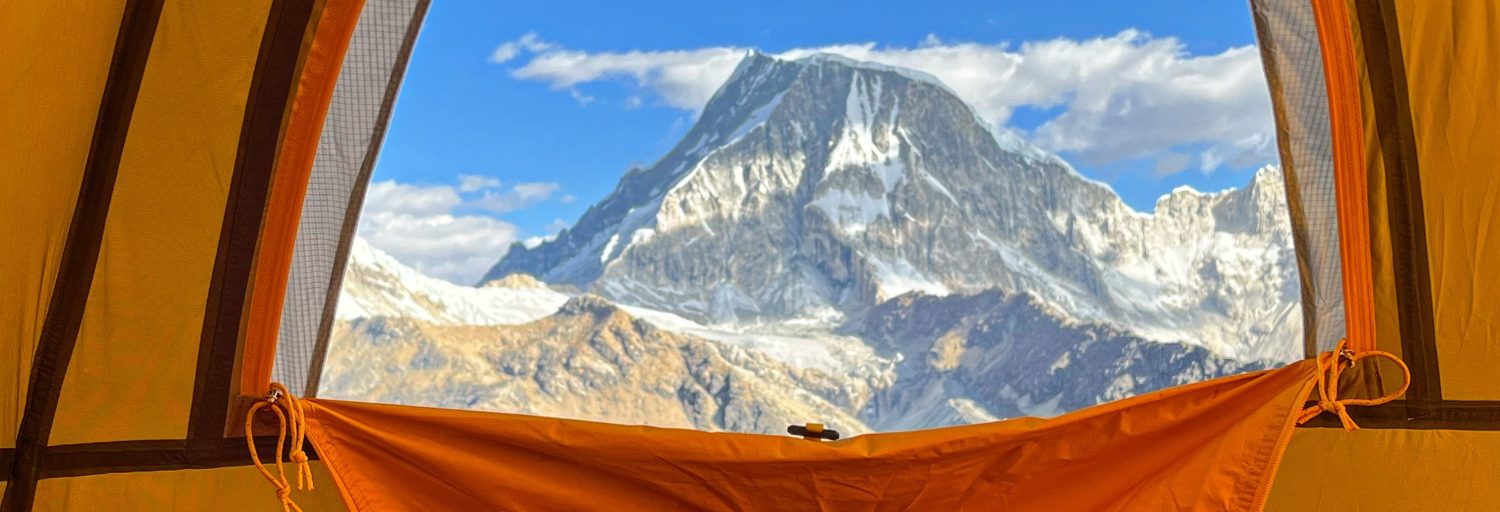
But that’s the huge elephant in the room, the heart of this issue, the unspoken challenge that is tearing an economic and idealistic hole through our underclass. Surface-level thinking and surface-level studying GETS YOU NOWHERE. Your degree is utterly worthless if you don’t dig beyond what is presented to you in school. Doing what our parents and our predecessors did will not yield the same results for our generation. The path to success leads nowhere. We need to think of that path as the trek to base camp; the real work begins when that trail ends. You can’t extend that trail with law school or graduate school; at a certain point you need to put your fears under you and start climbing. 

“You progressing on something, and that’s, that’s all about. You gotta keep moving, having a progress in your life.”

—Ueli Steck

Christopher Nolan’s “Interstellar” is less than stellar

Christopher Nolan is one of the best mainstream filmmakers working today. There are better, I won’t argue that with you, but there are only a select few artists in the mainstream who can consistently make blockbusters that are as visually pleasing, thought-provoking, and tense as those that bear the stamp of Syncopy, Christopher Nolan’s production company.

Nolan is one of the only filmmakers whose movies I will see without knowing anything about them. I went into “Interstellar” having seen a trailer or two, and not much else. I knew it was sci-fi, a genre I love, and from a man whose previous original projects included “Inception,” “Memento,” and “The Prestige.” Those are all fantastic mind-bending films which have a lot of flair. It’s hard to argue with a pedigree like that (although many online Steven Spielberg fans will argue with you about it until neither of you enjoys the discussion anymore).

Interstellar tries really hard to fit the same mold, but it just didn’t work for me in the same way Nolan’s earlier films did. Simply put: Interstellar is a decent film, but I left it in the theatre (along with eighty dollars, but that’s another story). My mind was already on tomorrow by the time the lights came up. I didn’t find myself immediately wanting to rewatch it, which is the way I felt after “Memento,” “The Prestige,” and “Inception.”

This may be because Interstellar uses less sleight-of-hand to keep audiences guessing.

Although the plot of the movie (I’ll keep it vague, promise) revolves around some fairly advanced astrophysics, information or understanding is never withheld from the audience. The critical scenes in the movie all have clearly defined stakes and rules. The movie progresses from plot point to plot point in a linear fashion. And even when the film ventures into strange territory and advanced theoretical concepts, there’s never much of a sense of mystery or wonder.

The cinematography is jaw-dropping and breaks its back to instill meaning and scale into the void left by a compelling plot. The score by Hans Zimmer is well-constructed, but unobtrusive (not usually a word I would use to describe the work of Hans Zimmer).

Matthew McConaughey as Cooper is the emotional center of the movie, and it is largely the strength of his performance that anchors the movie. Nolan clearly understood this, as he hangs the success this film on emotional appeal.

I’m a cerebral person. Although I can appreciate a good tearjerker or a quiet movie which silently swims on emotional subtext, I’ll take the guessing game of “Memento” over that stuff any day. At least in a Christopher Nolan film.

I left the theatre underwhelmed; my girlfriend came out sobbing.

I can’t say that “Interstellar” was a bad film; it clearly connected with her, and others I have spoken to about the film echo her sentiment. The film strikes a resounding emotional note. And for some people, that’s enough. Strike that note in the cold vacuum of space though, and it produces no sound.

Wherein I spend $80 seeing a movie at CinéBistro

Wine in movie theater

I took my girlfriend to see “Interstellar” this past weekend (Review here). We decided to do “dinner and a movie” on Sunday night, to celebrate her starting work (I work from home, and let me tell you, that’s difficult to do when your unemployed girlfriend is walking around in her underwear all day). This was a cause to celebrate, at least in a modest “dinner and a movie” way.

Dinner and a movie, Vail style, is a $100+ date. We spent $80 at the movie theatre.

Vail, 1, thisisyouth, 0.

Vail’s only movie theatre is, unsurprisingly, an upscale affair. Cinébistro at Solaris is a full-service concept, with menus and waiters and wine. It is without a doubt the nicest movie theatre I have ever been in.

The seats are leather, the leg room is spacious; Like most places in Vail, something about it really reminds me of money.

And that’s the thing.

Cinebistro makes it so incredibly easy for you to spend money. This, of course, is the goal of any movie theatre, with their $7 popcorns and $5 drinks and pulling you out of your home to do an activity which you could do from your couch. They trade convenience and the feeling of larger-than life luxury for extortionate sums of money. Cinebistro is maybe the apex of this idea.

When we arrived at Cinebistro on Sunday night, we had already eaten dinner and had two drinks apiece at the cheaper places in town. “Oh you guys are going to see Interstellar? I’m so jealous! I really want to see that movie. Isn’t it like three hours long though?” A bar worker asked us while we sipped on cocktails. “Yeah, that’s why we’re getting a little buzz on now,” I told him. “Very smart,” he said.

We had specifically chosen to eat and drink elsewhere because we did not want to spend too much money at the Cinebistro. Smart thinking that did not get us far.

Roughly 10 minutes before our screening, we arrived at the CInebistro. We paid $24 for two tickets (with the local discount), and reserved a pair of seats recommended by the clerk, which allowed us to extend the already spacious legroom by putting our feet up on the railing.

Thirty seconds after we sat down in the theatre, a waiter arrived and asked us if we would like some drinks. Two drinks deep already, of course we would like more. We order the cheapest bottle of wine on their menu and popcorn, and are out 56 more dollars. We are charged an automatic 18 percent gratuity for in-theatre service. From the time we entered the theatre to when we ordered food, maybe three minutes elapsed. There was little to do but laugh, exasperated, and say to one another, “We just spent $80 at the movie theatre.”

The movie was good. The experience was great. I’m still trying to come to terms with the fact that two of us spent $80 at a movie theatre.

Much like Las Vegas, Vail is a town designed to make you spend money.

I told this story over beers, to a group of pink-faced Vail Resorts employees who had been in town for all of two days; homeless and full of idealism. They all immediately pointed to our purchase of concessions as our issue. Which is obviously true. If we had skipped on snacks it would have been a much cheaper excursion.

A few weeks earlier, we saw “Gone Girl” at the Riverwalk Theater in Edwards, a town slightly down-valley from Vail. We drove ten minutes to the theatre and did not purchase concessions. It was a much cheaper outing (and for my money, the movie was better). But Edwards and Vail are very different places.

Vail is a resort town, an experience. To live in Vail without having the experience feels like a huge waste. Sure, you could skate by skiing, working, and drinking when you have the money, but why? Why live in a resort town if you’re not willing to make a little bit of every day a vacation?

If you’re not willing to do that, your heart seems like it would fill up with toxic hostility and resentment, full of the things you feel you can’t do.

This economic tension is one of the deep-rooted forces acting on the community of Vail. I’m very privileged to be able to thread the line of haves and have nots, but honestly, I can’t see doing it any other way.

Sometimes you need to eat rice for a month so you can afford an EPIC Pass (still waiting on mine to come in the mail, eek!), and sometimes the heart just needs an $80 movie.

“Money’s money.”

I infuriate my girlfriend whenever I tell her that. Usually this is in service of a “money’s not everything/ a poor craftsman blames his tools,” type of message. Her attitude is a little different. She has less saved up.

Money gives me a lot of joy, personally. My mother and my sister often took loans from me while I was growing up. I take good care of my finances; I acknowledge that a large amount of societal privilege has contributed to my possessing both money and the skills to manage it.

However, money’s never been the thing for me. You can’t put a price on experience; living life well is always more important than making money. This is why I’m here, blogging, working towards an audience and experience and a goal, instead of sizing boots or flipping burgers for $16 an hour in the town of Vail.

This is why I’m in Vail, to a large degree.

I work a day job, of course. Two, in fact. Hopefully more, if the tendrils I have laid play out. But you need to work for more than money, even at this age. If you are measuring your life in terms of how many $80 movies you can attend, something isn’t right.

But one every now and then sure doesn’t hurt.


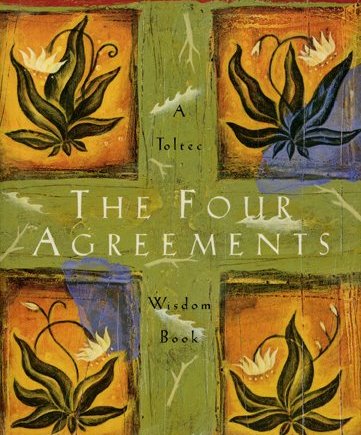
Book Review: “The Four Agreements”

Toltec Wisdom Book

My father gave me “The Four Agreements” by Don Miguel Ruiz for my birthday. My father is one of the most evenhanded people I know: he rarely gets angry, loses his composure, or even raises his voice. He practices Tai Chi twice a week. He’s pragmatic. He lives a simple life, not full of overmuch excitement, but also not full of any reversals of his good fortune.

I have learned a lot in recent years from my father. Once I decided to start paying attention, I found a lot of myself in him. Not an uncommon situation, I don’t think.

Right on the cover, “The Four Agreements” proclaims itself as a “practical guide to personal freedom.” Not many people are very free in today’s world. Whether its their iPhone, their spouse, their lack of funds, their anxiety, or their crippling fear of missing out, almost everyone I get to know has a laundry list of issues and neuroses which seem to interfere with their lives. I have my own, of course.

I run a blog called “This is youth.” I have a staked interest in making myself as free as possible.

I read “The Four Agreements” in one day. It is a short book, 140 pages double-spaced. The tone is conversational. The pages fly. This book is worth your day.

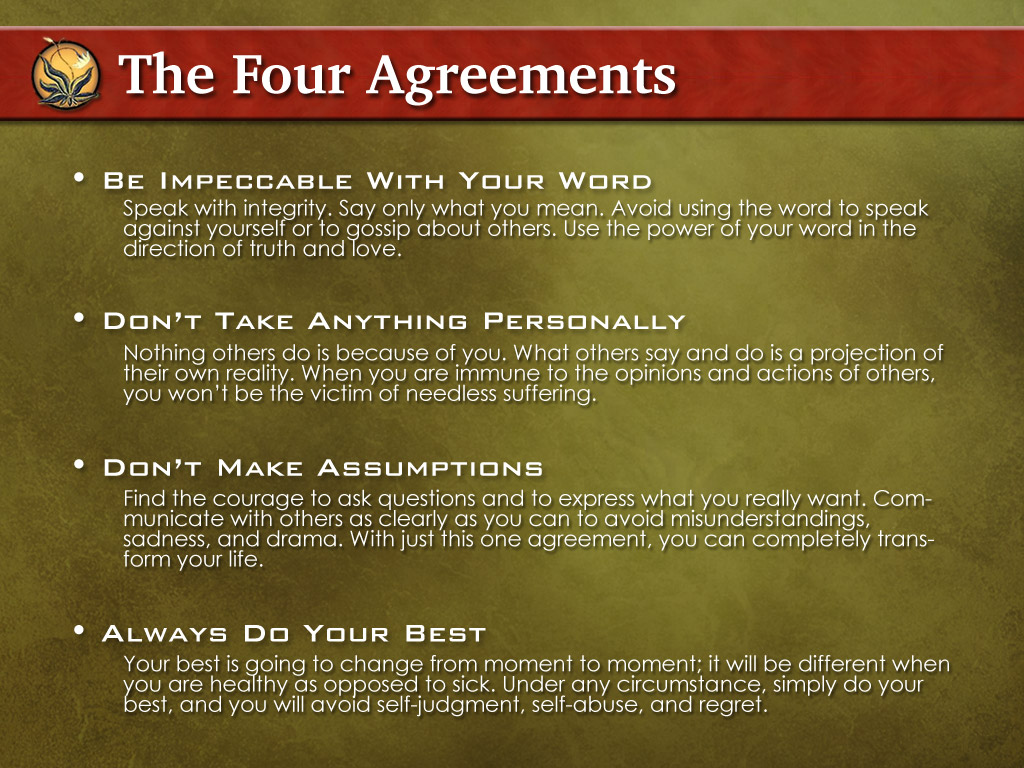
(But if you're too lazy, here's the basic Toltec thesis for a good life)

(But if you’re too lazy, here’s the basic Toltec thesis for a good life)

“The Four Agreements” puts forth a framework for experiencing the world based on ancient Toltec teachings. The philosophy of the book reminded me of Zen, in the way it advocates flowing with the world and letting go of resistances and ties to the past. These four Agreements in the text essentially recommend stripping away as much of the societal framework from your thinking as possible. It is not stated directly as such, but it’s hard to imagine the Toltec approving the way thousands of little ties with which we restrain ourselves every day.

Grudges, assumptions, personal feelings, what-if scenarios. These are all black situations which Don Miguel Ruiz advises you to leave behind. He encourages readers to embrace every moment of life anew, the way a child does.

While this line of argument may seem naïve and impossible, I challenge you to think about your own life. Things are usually best when we are fully in the moment, not preoccupied, not judging, not answering work e-mails on our smartphones. It is a difficult concept to consider, but really, why can’t we live our lives that way all of the time?

It may be idealistic, but hey. This is youth.