Book Review: “The New American Road Trip Mixtape” by Brendan Leonard

Brendan Leonard semi rad book

All that discussion of Jack Kerouac in my review of “The Book” by Alan Watts got me itching for a good old-fashioned road trip story. So I picked up “The New American Road Trip Mixtape” by Brendan Leonard.

I bought this book as a Christmas present for my girlfriend, entirely on a whim and with no more context than a few Amazon reviews. I did not realize that it would read very much like the sort of book I might write in ten years.

Leonard draws his inspiration from climbing, mountaineering, skiing and seeing the world through a lowly lens. His book chronicles a post-breakup period of dirtbagging around America in the back of a Subaru Outback. He even starts his odyssey in Denver. The similarity to my own sensibilities was simultaneously comforting and disconcerting.

The book is a quick read— I read the entire thing in the span of a few hours.

It is even printed double-spaced, like an assignment you would turn in for your writing class. It was self-published, which fits the ethos of the writing. The copyright page contains five lines. All that blank space is exciting.

“The New American Road Trip Mixtape” is adventure writing— quick, breezy and inspirational. To the sort of person who can identify with Leonard’s passions, the book will practically read itself. Those who can’t appreciate the appeal of the modern dirtbag lifestyle won’t find much of substance here.

It’s telling that two months since Christmas, I am the first one in the household to finish this book.

“The New American Road Trip Mixtape” differs from the writing I give you here in one key way. “The New American Road Trip Mixtape” is not a celebration of youth, but rather a chronicle of the end of youth. The book is about Leonard’s pivot into a deeper understanding of the world, not simply a celebration of living. The story is very much that of an inflection point in life.

“What is a life?”

This phrase is repeated often throughout the book. The full question, “what is a good life?” goes largely elided and unanswered. In the final pages of the book, Leonard sums it up as well as he can:

“There was something in everyone I knew in Utah, Montana, Washington, Oregon, and California figuring it out as they went, stubbing their toes and tripping sometimes, turning around after false starts and making the second or third try really count, making it as forever as we know how anymore.”

In the end, Leonard is quintessentially young, even as he chronicles his search for the way to age gracefully.

(You can find more writing by Brendan Leonard at his blog, semi-rad.com)

Book Review: “The Book” by Alan Watts

Philosopher Alan Watts

Dedicated readers will notice I updated the tagline in the banner.

“Ski town philosophy” is a much more apt summation of the blog these days. Something about the unchecked youth and recklessness pulsing around me makes me spiral into my head, and continuously think about the deeper things. When I’m not skiing or snowboarding, that is. Those activities remain, deeply, blissfully, entrancing. Outside of those hours, things make a little less sense.

I am more or less exclusively reading philosophy these days.

Alan Watts The Book modern cover

“The Book: On the Taboo Against Knowing Who You Are” by Alan Watts is a playful examination of our perception of our own selves, and how we interpret our place in the world. “The Book” considers the duality of existence, ultimately saying that such constructs as “in-group” and “out-group” suggest a complete unity of existence.

According to Watts, we should stop conceiving ourselves as “other,” an instead see ourselves as a part of the fabric of everything. To put the book’s thesis simply, an in-group can only exist by defining itself in terms of an out-group, thus, there is in fact no separation, and both groups are one and the same.

Watts’ rhetoric is surprisingly approachable, considering the topics he is touching upon. He flirts with Sausserian semiology at points, but his prose never becomes too dense, academic or unintelligible. I do think a basic understanding of semiology and semiotics (thanks English degree!) would provide helpful context for this book, but I wouldn’t say it’s necessary.

Watts writes well, and lays the groundwork for a lot of challenging thinking.

One can’t spend much time learning about Alan Watts without encountering his connection to the Beat Generation. Watts, an early Western evangelist of Buddhism, served as a forefather and guiding figure for young beat generation figures such as Jack Kerouac and Alan Ginsberg.

The beat generation and the millennial generation are kindred spirits, although the technological abstraction of our modern day keeps the two from being brothers. You could accurately characterize the two as like-minded cousins, perhaps.

The millennial chases “experience” and “life” above all. Raised in suburbs and by televisions, video games, and the Internet, ours is a generation with a vague sense of unease and rebellion. We don’t know what we want.

To put it in the parlance of the video above, we have a sense that the goal society has presented us with is a hoax, but we have no idea how to dance along with the music of our lives. Dancing to the music of life is where the beat generation excelled. These crazed bums knew a thing or two about how to live— or so it appears, half a century down the road. We must keep in mind what Jack Kerouac wrote in “On The Road”:

“I had nothing to offer anybody except my own confusion.”

From there, we must also understand that Kerouac died, angry and bitter, at the age of 47 due to cirrhosis of the liver. His days were spent slurring drunk, ecstatic in his escapism. Neal Cassady, Kerouac’s inspiration for the character of Dean Moriarty in “On the Road,” died at 42. Shortly before he died, he said:

“Twenty years of fast living – there’s just not much left, and my kids are all screwed up. Don’t do what I have done.”

The Beats, partially drawing their inspiration from Watts’ Buddhism and cohesive theory of existence, sought to live their lives like music. While Watts would argue that the Beat interpretation of Buddhism was somewhat different than his own, the Beats were drawn to Buddhism because they could not find the answers they wanted within their own culture.

“But the Westerner who is attracted by Zen and who would understand it deeply must have one indispensable qualification: he must understand his own culture so thoroughly that he is no longer swayed by its premises unconsciously.”

–Alan Watts, “Beat Zen, Square Zen, and Zen” 

Today’s millennials do not understand our own culture thoroughly enough. We are constantly swayed by corporations, conglomerates, and social media, trends which erode our idealism and cut away at our individualism, while seemingly promoting a culture of total acceptance.

Without the awareness of the forces, micro and macro, that act on us on an everyday basis, we cannot find our youth. We will be doomed to an indescribable malaise, a nagging sense of something wrong, something unfulfilled.

“The Book” is a good place to start on that journey of understanding.

Switching From Snowboarding to Skiing

After 15 years spent snowboarding, I made the switch to skis last month. Don’t get me wrong, I’m not turning in my board, but living in a ski town like Vail, I felt like I had no excuse not to know both disciplines.

(This reasoning tends to elicit a nervous nod and a quick change of subject from other, less ambidextrous Vail locals).

Like many boys my age, I chose to learn snowboarding because I grew up in the ‘90s, and snowboarding was the “cool” thing to do. Many enthusiast publications across the ski world thought that snowboarding would completely supplant skiing, a sport which was beginning to seem old and stodgy in the ‘90s. As a young boy growing up in Colorado, snowboarding was all that I wanted to do. Even though my father and my sister skied, the thought of trying to join them never once entered my mind. They tried to snowboard with me once: my sister took down an entire family with one sweeping turn; my stepmother bruised her tailbone so bad she never set foot on a ski mountain again. I was left as the only snowboarder in the family.

Since then, there has been quite the renaissance in skiing, thanks in part to the advent of terrain-park skiing (freeskiing), plus technological advancements which have made the sport of downhill skiing easier. Most recent estimates put today’s population split somewhere near 65 percent skiers and 35 percent snowboarders.

For myself, skiing has just always seemed like a more versatile sport. Skiers are more equipped for backcountry, mountaineering, and cross-country expeditions. If I wanted to expand my outdoors toolbox, learning to ski seemed like the next logical step.

Young skier, old skis

I learned to ski at Beaver Creek, Colorado on my stepfather’s skis: a pair of ancient Elan PSX Detonators. They were 188 centimeters long. These skis, at least 15 years old, were part of the reason people snowboarded so much in the late ‘90s and early aughts. They were awkward.

Nonetheless, they were free. I can put up with some physical discomfort if it saves me some fiscal discomfort.

Actually, there was really nothing wrong with the Elan skis. Their edge was fine, and they were fast enough after I gave them a quick wax in my garage. They’re totally solid skis, except that they’re a bit longer than is fashionable today. Beginners are generally advised to start with shorter skis, as it makes turning easier. But when it comes right down to it, skis are skis. They invent new styles every few years so they can keep selling you new gear.

Learning to ski

I fell a lot.

I fell a lot less while learning to ski than I did while learning to snowboard. Learning to snowboard hurts. Learning to ski is just a little awkward. The difference is huge. The learning curve is much more front-loaded on a snowboard, while learning to ski is a more gradual process. You can feel somewhat comfortable on skis by the end of your first day; it will take three days or so before a snowboarder starts to inherently understand the way his board is working.

Differences between snowboarding and skiing

As one might expect, the hardest part of switching from snowboarding to skiing is getting used to moving both feet independently of one another. On a snowboard both feet are firmly connected to the same object, while on skis you have full control of two separate legs. This is very disconcerting at first, and I ended up with my legs splayed in opposite directions more times than I would like to count. Not pleasant on the old hip flexors, learning to ski.

While snowboarders fall much more often in general, skiers have a much greater potential for serious injury due to the way a skier’s body can get twisted out of shape. A snowboard keeps the rider’s body aligned on a plane, which helps reduce the severity of crashes.

Luckily skiers are generally more controlled than snowboarders: a good skier will rarely crash. Snowboarders tend to be a little more playful, and thus end up with a face full of snow a lot more often. I noticed this dichotomy even in my own behavior: after five days on skis, I can now deal with black diamond terrain, but I am less likely to push myself or play around the way I will on a snowboard. For now, at least, I am content simply to cruise on skis. It could very well be the novelty just hasn’t worn off yet.

Lessons Learned from Switching From Snowboarding to Skiing

  • Chairlifts are way easier on skis.
  • Ski poles are just as awesome as you thought they might be.
  • Snowboarders are kind of annoying when you’re skiing.
  • There is a reason everyone bitches about ski boots so much.

Switching from snowboarding to skiing was surprisingly easy. Although I spent an hour or two spinning, falling, and bruising my ego, by the end of a half-day, I was confident and somewhat speedy on the greens.

It was not that easy when I learned to snowboard.

I think switching disciplines is overall easier than starting from scratch. As a transitioning snowboarder, I already knew how to read snow conditions and feel, as well as the mechanics of turning and stopping on an edge; I wasn’t intimidated by the mountain or the chairlifts. My basic knowledge of the environment allowed me to focus purely on form and technique, which was hugely helpful.

Now, with roughly around twenty hours on skis under my belt, I can ski black diamond terrain and medium-sized moguls without falling. I’m not the most stylish skier on the mountain, but I am improving rapidly and feel happy every day I can get out there and improve on my technique. For someone who had gotten very good at snowboarding to the point I was running laps all day on the double-black Chair 10, picking up skiing has revitalized my interest and sense of play on the mountain.

Chair 10 — Highline Express

Vail Double Black Highline Moguls

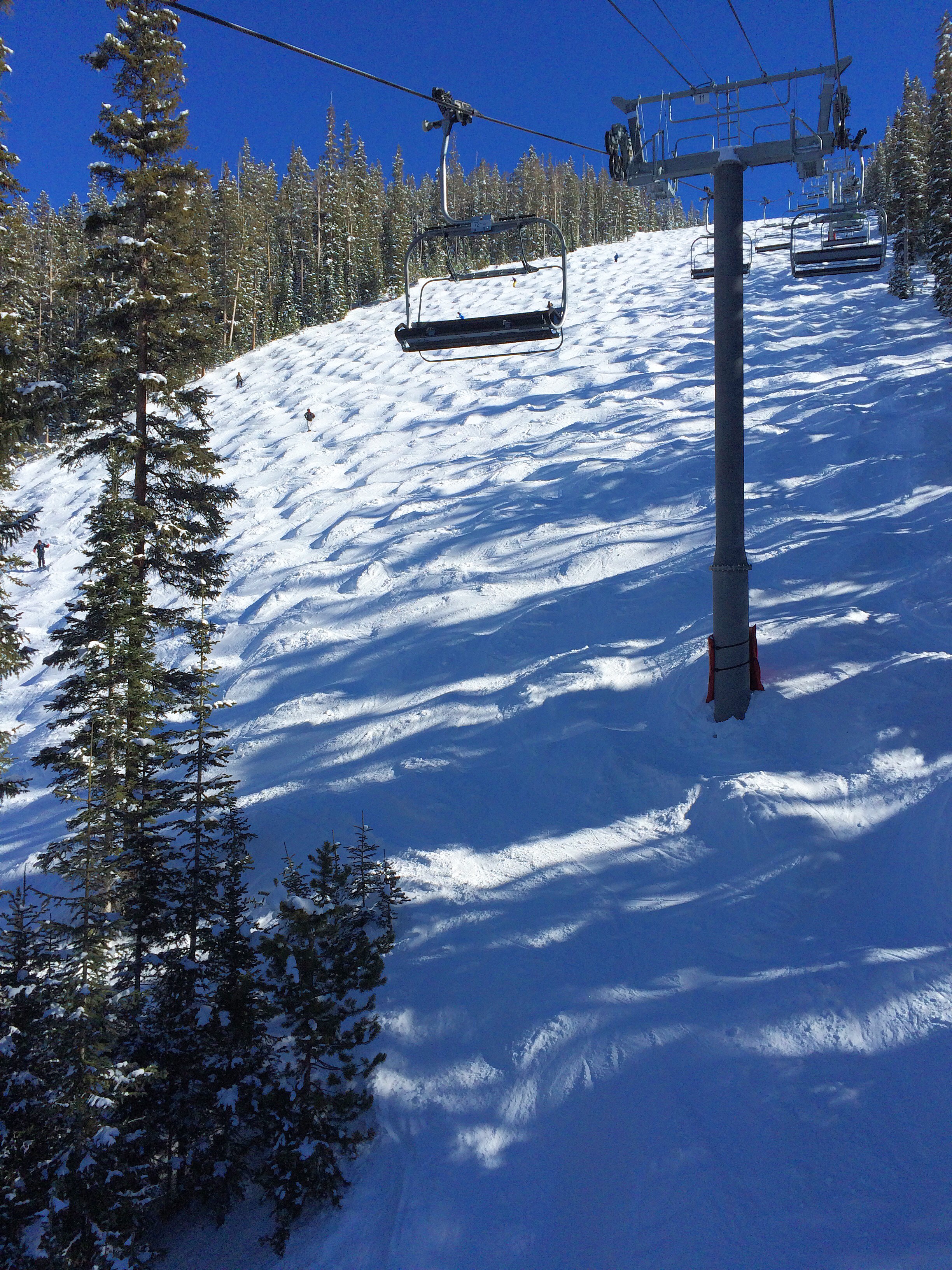
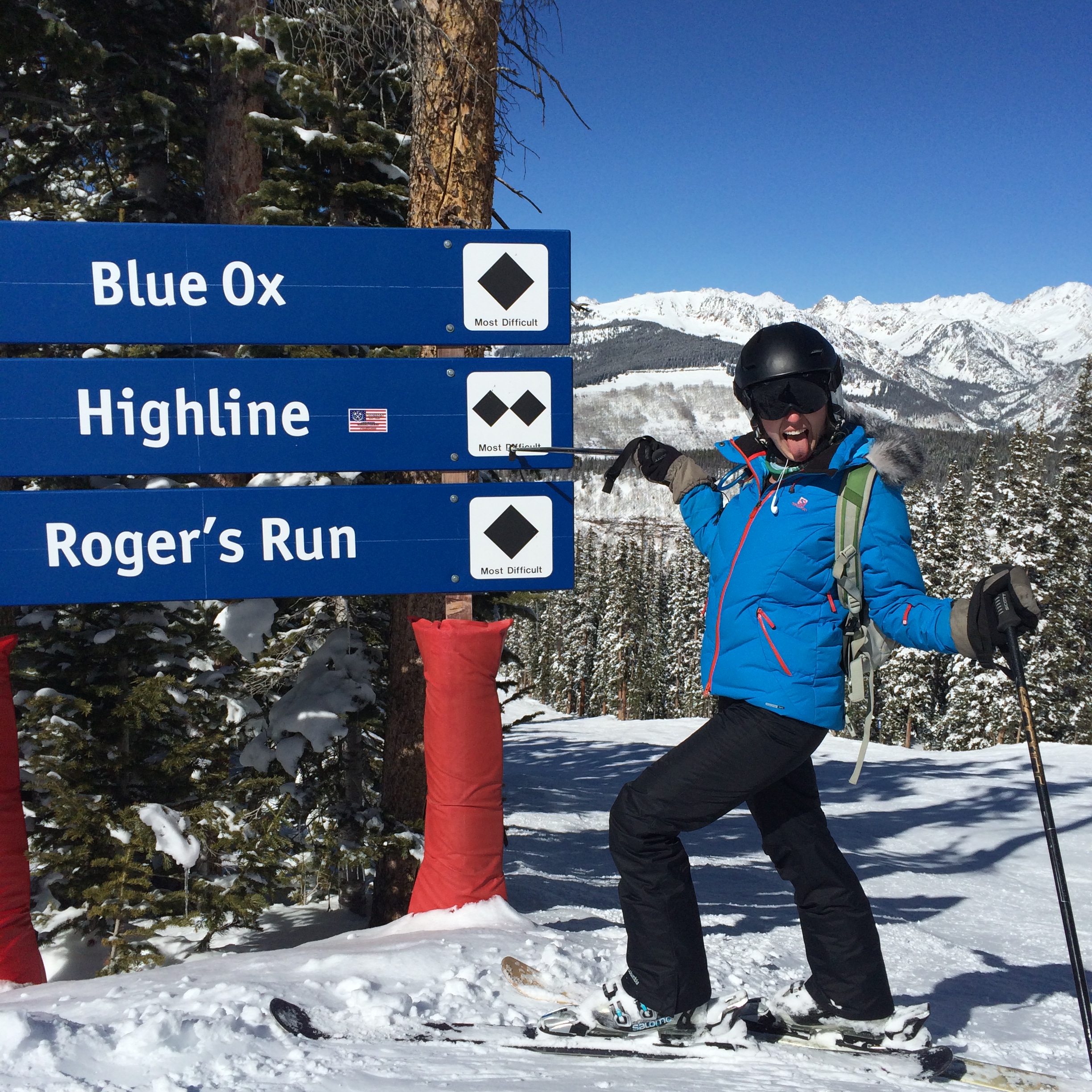
Vail’s Chair 10 is a perennial favorite with locals. Located to at the Eastern border of Vail’s frontside (far-left on the trail map), Chair 10 services black and double-black mogul runs. (It is also the quickest way to Two Elk Lodge and China Bowl; a little-known secret).

Chair 10 Trail sign Vail

For the dedicated mogul skier, there is no better terrain on Vail Mountain than Chair 10. There is rarely a line at the base, allowing for endless laps on endless bumps. If you opt to follow the liftline down the double-black Highline run, prepare for cheers (or jeers) from spectators on the lift evaluating your performance.

Gore Mountains in Vail, ColoradoChair 10 also provides some of the best views of the Gore Range which can be found anywhere on Vail mountain.

On a powder day, Chair 10 can provide a mellow and empty alternative to the always-too-crowded Back Bowls.

San Diegans in Snow

EpicMix photo example

Long time no see, folks. Sorry for the break. I’ve mostly just been skiing and snowboarding too often to write much. Vail’s gotten smashed with snow over the last week (two feet!), plus I learned to ski after being a lifelong snowboarder. I was on the mountain every day last week, concluding with a trip to Keystone Resort in Summit County yesterday to see some of my fraternity brothers who are visiting from San Diego, California.

Continue reading