
I have never seen a city as green as Chiang Mai.
I don’t mean environmentally— waste actually seems to be a big problem here— I’m talking about color. I’m talking about plants.
This is a city that can barely be seen amongst the trees.
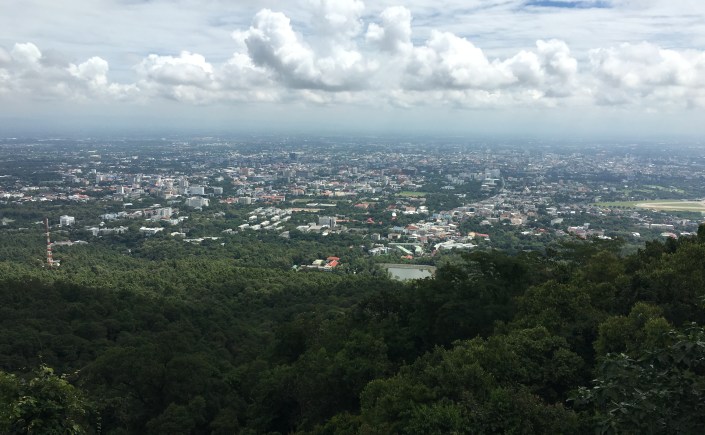
I don’t mean environmentally— waste actually seems to be a big problem here— I’m talking about color. I’m talking about plants.
This is a city that can barely be seen amongst the trees.

The number one tourist attraction in Chiang Mai, Thailand is Wat Phra That Doi Suthep, the temple on the mountain above the city. For tourists, it is colloquially referred to as Doi Suthep.
Doi Suthep is a Theravada Buddhist temple, built in 1383. The temple is located atop Doi Suthep, the mountain just outside Chiang Mai. As legend has it, the site was chosen by a white elephant. The elephant was released into the wild carrying a sacred relic. Eventually the elephant wandered to the spot of Doi Suthep, trumpted three times, and then died. The king of Lan Na (Northern Thailand) took it as an omen, and ordered a temple built upon the spot.
Over the years the temple has been expanded and embellished, resulting in an ornate complex plated in gold and adorned with hand-painted murals from the life of the Buddha.


I live out of a Tortuga backpack now.
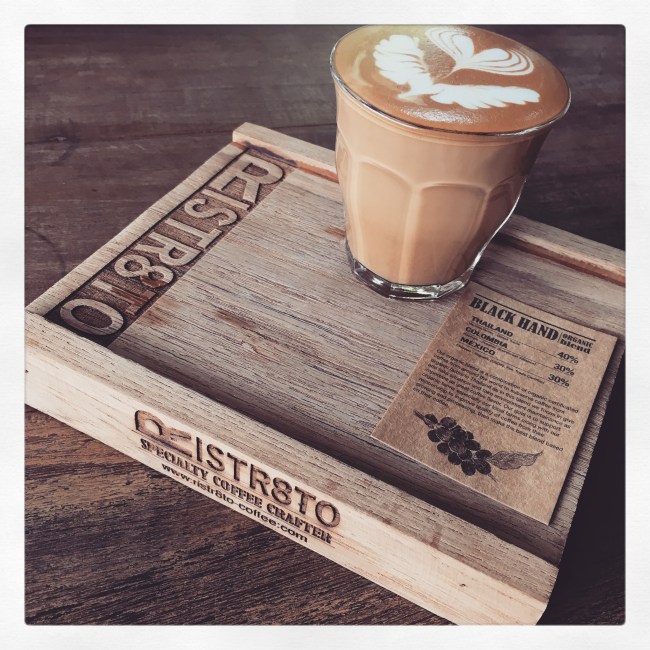
I’m typing to you from one of the innumerable coffee shops of Chiang Mai, Thailand. Imagine your coolest local coffee shop. Now multiply its best qualities– its charm, its atmosphere– by ten, and then duplicate the result a thousand times, each clone with a unique twist. Now scatter those coffee shops five to a block, with another six down the alleys. This is Chiang Mai. The coffee never stops.
This is my first major travel outside of the United States, my home. Once the plane landed and the stomach-clenching anxiety cleared, it turned out to have been easier than I had imagined.
As it turns out, every travel blogger ever was right. It’s not that hard.

When I graduated college, I was already employed in my field. I was working remote, freelancing for a news startup called Inside.com. I was being paid peanuts: a contract rate that effectively worked out to well below minimum wage. I told the hordes of well-wishers at my graduation party that it wasn’t really a “real job,” just something to pay the bills and build the resume. I was looking. Fifteen months, several raises and rounds of layoffs later, I still work for Inside. At the time, I definitely didn’t realize how lucky I was. Although Inside has never paid me too much, they do allow me unlimited flexibility, a perk which absolutely cannot be overvalued.

A year is a long time, when looking to the future; in retrospect, a year is almost unbearably short.

One year ago.
I have now lived in Vail for one full year of my life. My 22nd year on Earth, I spent in Vail. My 23rd, I will spend in Asia. I hope it will be better.
Although on August 1, I knew a year had passed, the length of time somehow didn’t hit me until I attended the 2015 Vail International Dance Festival.
Watching the 2014 VIDF was one of the very first things my girlfriend and I did after moving to Vail. To return to the same spot, for the same activity, with a year between, really forced me to reflect on my year in a ski town.
The Vail International Dance Festival is an annual, two-week long celebration of classical and modern dance. Programming showcases everything from traditional ballet to YouTube sensations to newer, more urban styles of dance. There’s dancing in the streets, in the air; during these two weeks you might even catch some better-than-usual dancing in Vail’s limited number of bars. Where else can you take shots with world-famous ballerinas and dancers and not even know it?
That’s the thing— you might be able to brush elbows with those sorts of people in certain neighborhoods of New York City, or LA, or London, but you would know it. People who live in the hip neighborhoods know why they are there, and they know the pedigree that surrounds them.
Young people in Vail are almost completely ignorant of this pedigree.
 thisisyouth