North Face Cobra 60 First Impressions

(“First impressions” is a bit of a misnomer for this post, as I’ve now used this pack for around 30 days. However, I used the older rendition of this backpack for 5-6 years, so in my opinion, I am indeed still forming my first impression.)

I beat the ever-loving-hell out of my previous Cobra backpack. For years, it served for any purpose I needed it: cragging pack, international travel, overnight backpacking, ice climbing, alpine rock climbs. That pack went with me to Europe, to the top of the Grand Teton, to Mount Baker, to alpine ice climbs in Rocky Mountain National Park, and elsewhere. It finally died this summer in Peru — split along the bottom after I overloaded it, trying to fit seven days of supplies in a 60-liter pack.

North Face generously warrantied that pack, sending me the updated version. I have now taken this pack on a few outings, including local day trips around Boulder, an overnight climb of the Fisher Chimneys on Mount Shuksan, and five weeks of climbing and cragging in Indian Creek, Utah. Here are my initial impressions.

Continue reading

Rock Art

I’ve just emerged from a seasonal sabbatical in the desert. As usual, we did a lot of rock climbing. The climbing out there is always good – but we won’t linger on that here.

One of the more fascinating aspects of the deserts of the American southwest is the cultural heritage. Artifacts and rock art from a number of Native American cultures are visible here. These things aren’t in a museum or on a heavily-trafficked tourist trail: for the most part, they’re just sitting in the desert, scratched on the side of soft sandstone walls or sitting deep within remote canyons.

There is a special feeling I get when I walk up to these sites. I am not a religious person, but from the first time I saw ancient petroglyphs scrawled on a wall, I felt a spiritual presence. There is no other word for it, and it’s a feeling I still get at many of these sites.

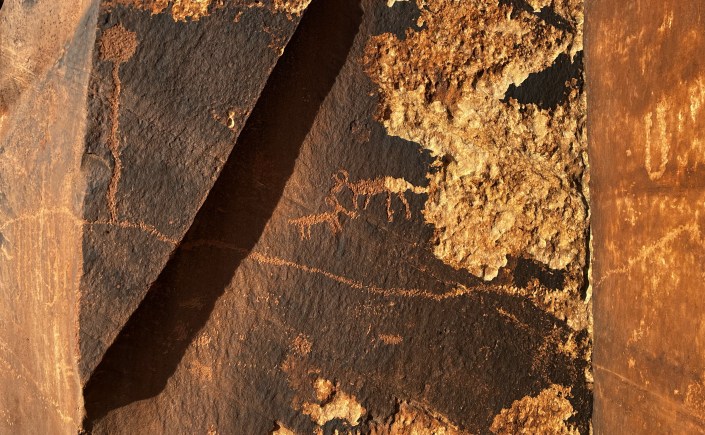
Primitive pictures carved into dark sandstone. Recoghnizeable figures include a person, a Kokopelli, handprints, and depictions of antelope or similar animals. There are also abstract shapes, including a triangle and a snake-like squiggle.

Andrew Gulliford, in his book “Bears Ears: Landscape of Refuge and Resistance”, writes:

“In Navajo belief, a dead person’s spirit may continue to reside where that person had lived and died. Their chindi or spirit may be lonely and seek to haunt or terrorize visitors.”

“Bears Ears: Landscape of Refuge and Resistance”, 2022, Andrew Gulliford, page 103

I don’t feel a malevolence, but I do feel a presence. I encourage you to visit yourself — maybe you will feel it too.

Continue reading

Book Reviews: Two Epics

I write you from the Moab public library – a remarkably good library for such a small town. Town is for resupply: ice cream, burgers, wifi. The rest of the Fall season we spend in the desert — the true desert: long drives, hot days, cold nights, far from service. A good book is essential. A long and involved one, ideally.

Continue reading

Shaqsha, SE Face

Shaqsha is an obscure mountain for Peru, despite the fact that it graces the cover of Brad Johnson’s “Classic Climbs of the Cordillera Blanca”, the most popular guidebook for the area.

A great book – exceedingly hard to find these days.

Shaqsha was not on my radar at all until a chance meeting with Alejandro Urrutia and Rodrigo Ramos, a pair of Mexican alpinists. They were sitting in Cafe Andino, a western-style coffee shop in Huaraz popular with climbers, making a topo of a traverse of Chopicalqui they had just completed, from the SE ridge to the SW ridge.

They had been sick half their trip, they said, but had also managed to sneak in Shaqsha, via the left side of the ridge. A good climb, easy. “The right side also looked good,” they said, showing a photo of their tent pitched on the glacier in front of the face.

I wanted that picture. And off we went.

Continue reading