

(“First impressions” is a bit of a misnomer for this post, as I’ve now used this pack for around 30 days. However, I used the older rendition of this backpack for 5-6 years, so in my opinion, I am indeed still forming my first impression.)
I beat the ever-loving-hell out of my previous Cobra backpack. For years, it served for any purpose I needed it: cragging pack, international travel, overnight backpacking, ice climbing, alpine rock climbs. That pack went with me to Europe, to the top of the Grand Teton, to Mount Baker, to alpine ice climbs in Rocky Mountain National Park, and elsewhere. It finally died this summer in Peru — split along the bottom after I overloaded it, trying to fit seven days of supplies in a 60-liter pack.
North Face generously warrantied that pack, sending me the updated version. I have now taken this pack on a few outings, including local day trips around Boulder, an overnight climb of the Fisher Chimneys on Mount Shuksan, and five weeks of climbing and cragging in Indian Creek, Utah. Here are my initial impressions.
Color
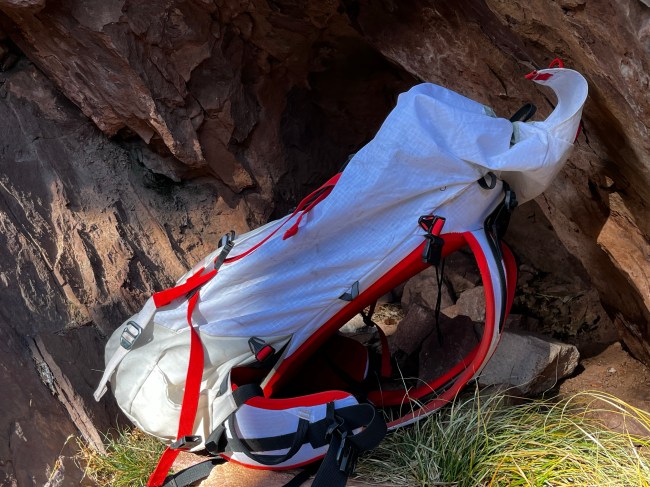
The most obvious change with the new edition of the Cobra pack is the color. The old version was black, while the new edition is semi-transparent white. The North Face claims that this is so you can see what’s inside the pack, and for increased reflection in a search and rescue scenario. I think it’s just because you can’t die dyneema, the material of which the pack is made.
Whatever the reason, you’re sure to get comments on the blinding-white color.
After a month of use, my pack has acquired a few blemishes, and I’m sure it’ll get more. If you plan on using your gear, this shouldn’t be an issue. If you want your kit to remain pristine-looking for as long as possible, you might consider a different direction.
Features

This pack replicates the featureset of the old Cobra pack, focusing on mountaineering. Key features include: ice tool carry, crampon pocket with drain hole, two wand/picket pockets, helmet carrier, detachable brain, and compression straps on both sides for ski/rope carry. There is also a top-loading interior pocket for a hydration bladder or a climbing guidebook.
The ski carry and ice tool carry have been significantly improved from the previous generation of the pack, which is welcome. The wand/picket pockets remain too small to adequately secure pickets when the pack is fully loaded, which is a baffling decision. I had my pickets repeatedly make escape attempts while I was using the Cobra in the Cordillera Blanca, and I can already tell this revision will have the same problem. If your pack is under-loaded, these side pockets will work well, but with a full load they won’t do much. If carrying pickets, you’ll definitely want to attach them to the pack using the upper compression straps.
The detachable brain went from a four-point attachment system to a three-point attachment system, a change which is not sitting well with me so far. The old Cobra used four buckles (two in front, two in back) to attach the brain, while the new one uses two buckles in the back and a single hook and loop closure in the front. In my experience, this makes the brain prone to sliding off to one side, especially if you are carrying a smaller load in the main pack. It may also be harder to replace the hook-and-loop closure if it breaks.
One feature missing from this pack is tent loops. They are nowhere to be seen, and will need to be added or your tent/sleeping roll placed inside the pack.
Suspension
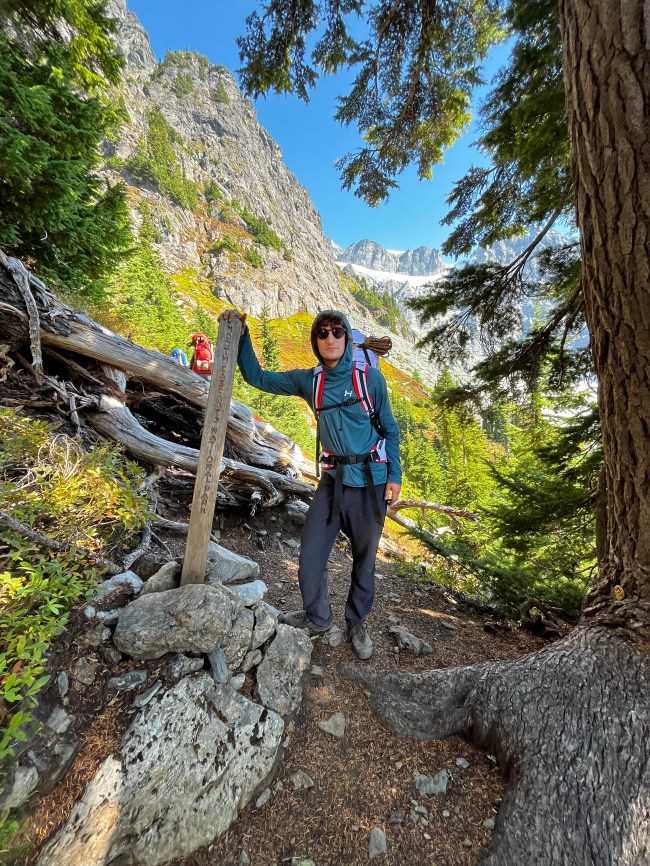
One other notable change made to the pack was the addition of significant padding to the shoulder straps and suspension system. The old version of this pack had very flat shoulder straps and hip belt — a slim, lightweight system. While that felt good when climbing, it became very painful when carrying large loads. I’m appreciative of the extra padding, which came in handy on Mount Shuksan, where we walked long distances with our overnight gear. The climbing performance of the pack suffers a little bit, but it’s a worthwhile trade off. The new version still climbs better than most packs in this class.
Durability
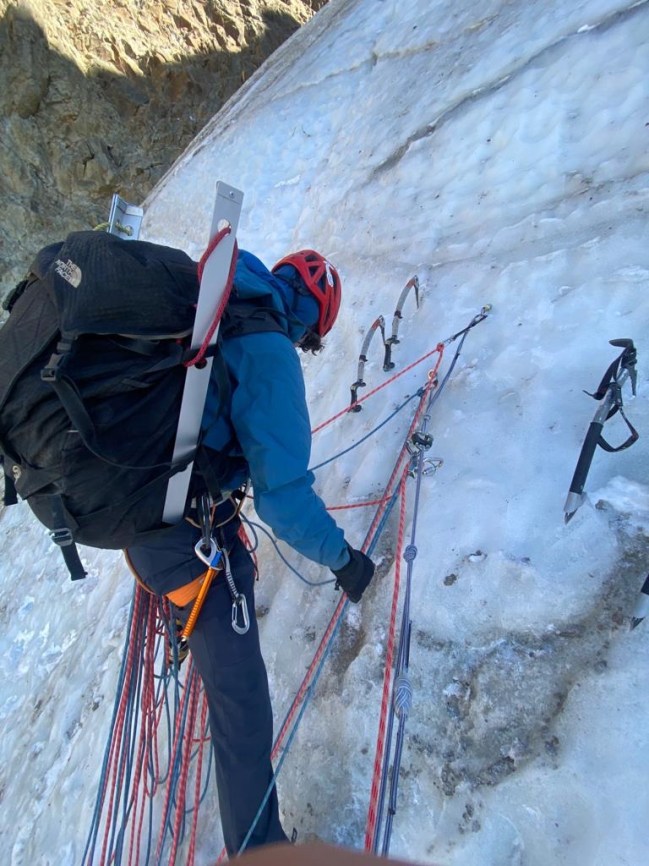
The older version of the Cobra backpack (pictured above) lasted me years of extremely heavy use, including a lot of time up-close-and-personal with sharp ice climbing gear. I’ve had the new one for only a few months, and as such, can’t accurately compare their long-term durability. However, the dyneema material used in the new pack is well-proven to be extremely durable and cut-resistant. This is the same material used in the popular Hyperlite Mountain Gear packs. I think this pack will last a long time. My main concern is that the drawstrings on the main compartment closure and on the ice-tool carry seem a little flimsy — I could see these being weak points as the backpack ages.
Overall

The redesigned North Face Cobra 60 backpack maintains most of the great features of the old pack, while also boasting a more supportive suspension and a new dyneema body material. I used the old pack extensively and can tell you that you won’t go wrong with this new one (“new” in quotations, because this redesign has been out for a couple of years, now).
While it’s not the perfect pack for a long expedition, the Cobra is the perfect pack for 1-3 day trips where you will be doing technical climbing, and might not want to bring a summit pack. It’s also a great cragging pack, with sufficient space for a rack, a rope, and a few layers with no need to play Tetris.
I really enjoyed the old version of this pack, and so far, the new version seems to carry on that legacy.
 thisisyouth