
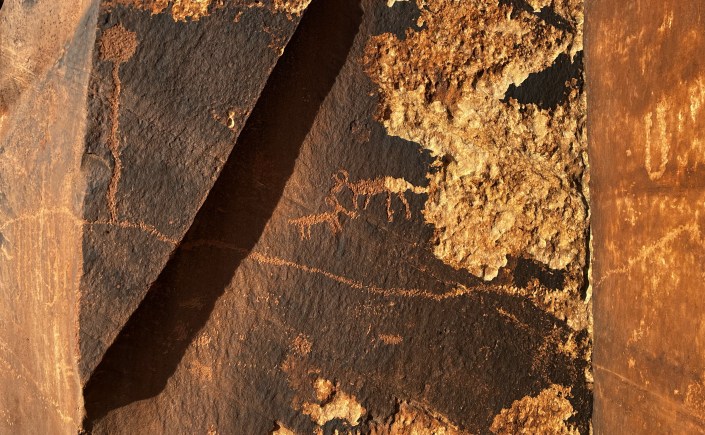
I’ve just emerged from a seasonal sabbatical in the desert. As usual, we did a lot of rock climbing. The climbing out there is always good – but we won’t linger on that here.
One of the more fascinating aspects of the deserts of the American southwest is the cultural heritage. Artifacts and rock art from a number of Native American cultures are visible here. These things aren’t in a museum or on a heavily-trafficked tourist trail: for the most part, they’re just sitting in the desert, scratched on the side of soft sandstone walls or sitting deep within remote canyons.
There is a special feeling I get when I walk up to these sites. I am not a religious person, but from the first time I saw ancient petroglyphs scrawled on a wall, I felt a spiritual presence. There is no other word for it, and it’s a feeling I still get at many of these sites.

Andrew Gulliford, in his book “Bears Ears: Landscape of Refuge and Resistance”, writes:
“In Navajo belief, a dead person’s spirit may continue to reside where that person had lived and died. Their chindi or spirit may be lonely and seek to haunt or terrorize visitors.”
“Bears Ears: Landscape of Refuge and Resistance”, 2022, Andrew Gulliford, page 103
I don’t feel a malevolence, but I do feel a presence. I encourage you to visit yourself — maybe you will feel it too.
Where Is The Rock Art?

While this stuff isn’t exactly secret, I also am not interested in providing exact locations or GPS coordinates here. These are sensitive sites, and unfortunately, many rock art panels in the area have already been vandalized. Take a close look at the image above; do you see the bullet hole??
In this post, we’re generally talking about this region of Southeastern Utah:

(Map courtesy of GuestGuide Publications)
There is rock art and native ruins all across the Four Corners region, most spectacularly preserved in Mesa Verde National Park, in southwestern Colorado, and Chaco Canyon in New Mexico. A comprehensive study would require a book, a few of which I’ll provide links to purchase later in this post.
What Do The Rock Art Pictures Represent?
This, it turns out, is still a largely unanswered question. The Ancestral Puebloans (Anasazi) and Fremont peoples that left these glyphs practiced an oral storytelling, meaning no written records were left for modern archaeologists. The ancestors of these people may have some interpretations, but they are not shared with outsiders.
Some panels are straightforward to interpret. Can you figure out what’s depicted in this petroglyph?
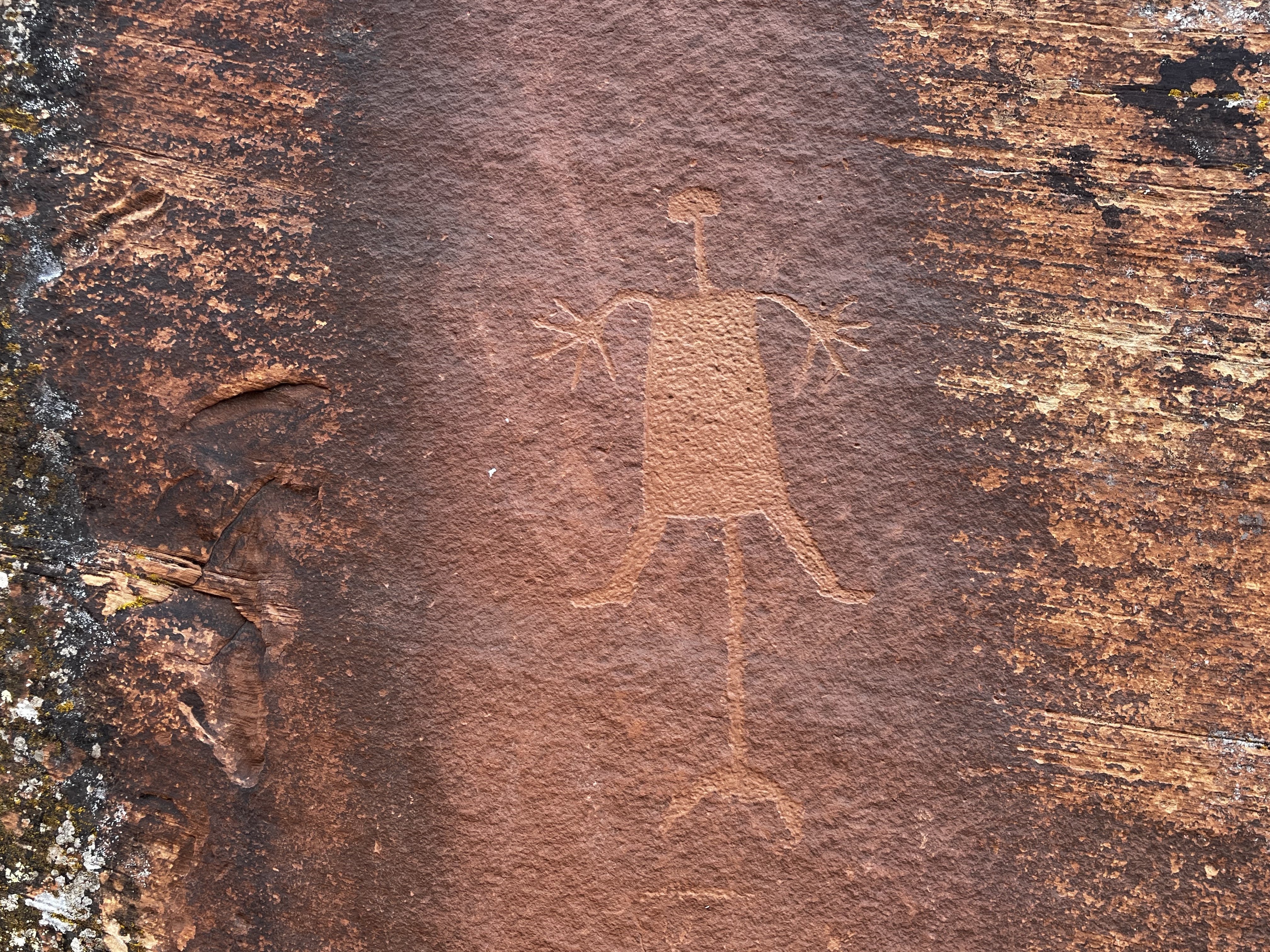
Any guesses?
You sure?
It’s a birthing scene, showing a mother and a newborn baby, still connected by the umbilical cord. Depictions of birth are quite common. Other glyphs can be much more abstract.

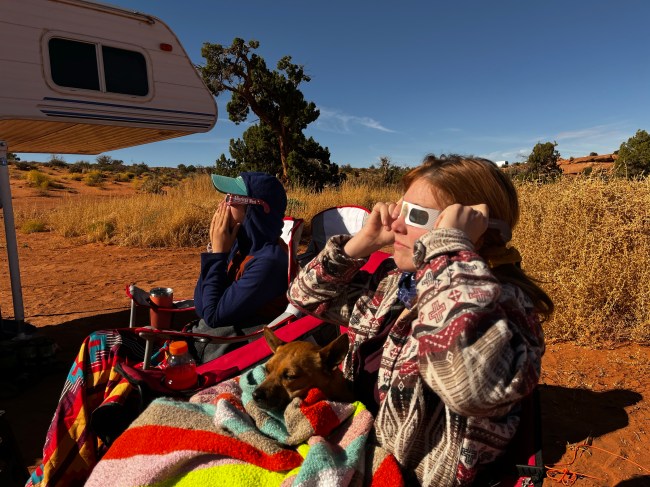
What do you think is happening here? I read it as astrological – some representation of the moon, sun or the planets. Perhaps an eclipse, like the one we witnessed in the area this October??

The National Park Service has an interesting page on the topic of “Reading Rock Markings,” here.
Who Made the Glyphs?

“Moab Mastodon” petroglyph, photo credit gjhikes.com
The oldest petroglyphs in the region date back to potentially 13,000 years ago, with several petroglyphs depicting mastodons or wooly mammoths, which roamed the area around that time period. There remains healthy debate about the authenticity of these glyphs, however.
We do know that Archaic native cultures made their mark on the sandstone walls of this area thousands of years before the birth of Christ. In the millennia that followed, there is evidence of newer generations and cultural groups re-visiting the same areas, and adding their own art to that placed by the ancients.

The red figure in the background is an example of the archaic style, and likely dates to more than 2,000 years ago. The white dots, which are part of a larger horizontal display, are more contemporary.

Handprints, one of the more common motifs. Note the two different style of handprints left here: “positive handprints”, created by placing paint on the hand and then touching the wall, and the prominent “negative” handprint, created by blowing the white substance around a hand placed on the rock.
The practice of rock art continued up until the natives were driven out of the area. It’s always a particular delight for me to spot a mounted cowboy with a rifle in the drawings — an easy-to-identify marker of more contemporary panels.
In an example of cultural synthesis (or appropriation, if you like), you can even see instances of white settlers carving their own images or initials into the rock. While today this would be considered vandalism, at the time the perpetrators may have simply viewed themselves as adding to an eons old ledger, leaving their mark where others had been before.
Where to Get Information on Rock Art?
Rock art is both a well-known and little-documented phenomenon. Finding surface-level info on the topic is easy, but serious scholarship is lacking, and detailed directions to panels and information on more spectacular, remote sites can be difficult to track down. I won’t do all the work for you, but if you’re interested, let me point you in a couple directions:
The bookstore Back of Beyond in Moab specializes in “natural history and regional titles of the Colorado Plateau,” and is well worth a visit. They have a large number of books on local history, anthropology, archaeology, as well as difficult-to-find guides and a seriously impressive collection of historical materials. Not all books are listed on their website.
The Moab Visitor Center sells a small pamphlet with a “Driving Tour of Moab Area Petroglyphs.” This is a great place to start, although since all the panels depicted are easy to access, many have been vandalized. Other regional visitor centers in Bluff, Blanding, and Monticello are also staffed by knowledgeable and helpful locals. A stop to chat and peruse their materials is highly recommended.
If you are looking to research from home, here are a few books which you can purchase on Amazon about the topic:
- Ancient Ruins and Rock Art of the Southwest: An Archaeological Guide, by David Grant Noble
- Hiking Ruins Seldom Seen: A Guide To 36 Sites Across The Southwest, by Dave Wilson
- Rock Art of Utah, by Polly Schaafsma
- Bears Ears: Landscape of Refuge and Resistance, by Andrew Gulliford

Ruins
Rock art is not all these ancient cultures left in the desert. Many structures including homes, fortresses, and granaries remain. Unfortunately, many of these structures have been looted of their valuable artifacts (a federal crime). If you venture far enough off the beaten track, however, some mystery still remains. If you’d like to see a professionally managed exhibition of ancient pottery such as might have once filled these ruins, the Edge of the Cedars Museum in Blanding, Utah offers an excellent collection.

A granary, used for storing food such as corn. Note how the building makes use of the natural geology.

A remarkably well-preserved dwelling, again located under a natural sandstone roof.
Sandstone Roofs
As noted above, much of what remains in canyon country was protected under natural sandstone roofs.
Pictographs, or art made with paint/pigment, virtually only survived in sheltered areas. Petroglyphs, or carvings made in the rock, have fared better in the elements.
Nonetheless, it’s easy to imagine how much of this heritage has been eroded away over the centuries.


Closing Thoughts
I felt the holy spirit at these sites.
It’s simultaneously shocking and refreshing that these artifacts remain in the desert.
The European/colonial mindset I grew up with tells me that these things should be in a museum. And many of the more spectacular ones are. For example, the famous Cougar petroglyph which was moved from its original location of discovery, and now resides as a tourist attraction at the Painted Desert Inn, in Arizona. Utah and Colorado canyon country was also subjected to pretty widespread graverobbing and pot-hunting in the late 1800s and early 1900s — something which led US President Teddy Roosevelt to pass the Antiquities Act, which made disturbing such cultural sites a federal crime.
Despite all of that, much remains out there in the wilderness. If you can: tread lightly, respectfully, and go see it with your own eyes. This land is a priceless American treasure.
 thisisyouth
Thank you for this post—the petroglyphs are stunning. We spent some time in Sedona, AZ this summer and visited some protected sites.