

Information about this peak is a little scarce or outdated online, so I thought I would provide a 2023 update. (2024 update: the glacier tongue shrank and technical ice section is now subject to bad rock/icefall. Guided groups are attacking it in the middle of the night to mitigate risk. As you’ll see if you read this post, that was not at all the case last year, we climbed in full daylight. For more on this topic, see my 2024 post, Climate Change in the Cordillera Blanca.)
Huarapasca is a mountain at the southern end of the Cordillera Blanca, in Peru. It is notable for an extremely short approach, by Cordillera Blanca standards, as well as a 100-140 meter section of AI3/WI3 – legitimate ice climbing. It is one of only a handful of peaks in the area which you can do in a day and back from Huaraz.
Although once considered an obscurity, it saw quite a bit of traffic this season (2023), with several agencies in Huaraz promoting the mountain as a guided offering. People who have climbed it in years past say the mountain is becoming icier.
We did this mountain independently, in a team of five, with three novice ice climbers. Although we had the summit, I would not necessarily classify this as a beginner ice climb. It is more of an intermediate objective, I’d say. Nonetheless, I’ll give my account of the climb.
The Approach

Huarapasca is located about 2-2.5 hours drive from Huaraz, near the Pastoruri glacier. You can drive to within about 1km of the Huarapasca glacier, which is WAAAAY easier access than most other nevados (glaciated mountains) in the area.
From the road it is a short, simple walk to the base of the ice climbing.
The Logistics
Huarapasca Trailhead GPS Coordinates: -9.867200, -77.178318
Technically this climb is located within Huascaran National Park, but if you enter before sunrise, there should be no one manning the checkpoint. Still, if you have a pass it doesn’t hurt to bring it.
If you have access to a car, you can drive yourself. If you do not have a car, some agencies in Huaraz will advertise prearranged transport on certain days – look for the signs outside the storefronts near Parque Ginebra. If you prefer to go totally independently, you may hire private transport to take you in the morning, wait at the trailhead while you climb, and then return you to Huaraz upon completion of your climb.
In 2023, the going price for a private taxi to and from Huarapasca was 300 soles. Since we were a group of 5, and too big for a taxi, we hired a private Sprinter van for 400 soles round trip. Arrange this through an agency. The transit should pick you up at your lodging. We left at 2:45 a.m. and this was about right to reach the ice shortly after sunrise.
Climbing Huarapasca

From the side of the road, the trail doesn’t look too promising. You cannot see the upper mountain nor the glacier, but they will soon arrive. Older reports mention a sign at the trailhead, but in 2023 we found just a rock cairn and little else. The trail heads up a sandy, ill defined wash for a bit, before becoming a bit more obvious at the top of the hill. Follow the cairns, trail, and your nose to the base of the glacier, a steep tongue of snow and ice. It’s the only glacier around, so you’ll find it hard to get lost.

The initial steep section of the climb is about 200 meters, and it is the main attraction. In 2023 it offered about 100 meters of unrelenting, blue ice climbing. I would grade this WI3 – it climbed exactly like water ice at home in Colorado. Many people around town complained of this being “bullet-hard” ice, which may be true for the area, but it felt like a normal waterfall ice climb to me so I’ll assign it a WI grade, not an AI grade. The angle of this section was 55-65 degrees, I’d estimate.


Ice screws to your comfort protect this section. The face was littered with old v-thread tat, but I wouldn’t recommend trusting these – we removed three which had completely melted out of the ice, AND I heard a local guide (our only company on the climb) telling his client to hook the threads with her tools to progress.
A hanging or semi-hanging belay will be necessary in the middle of the ice face.
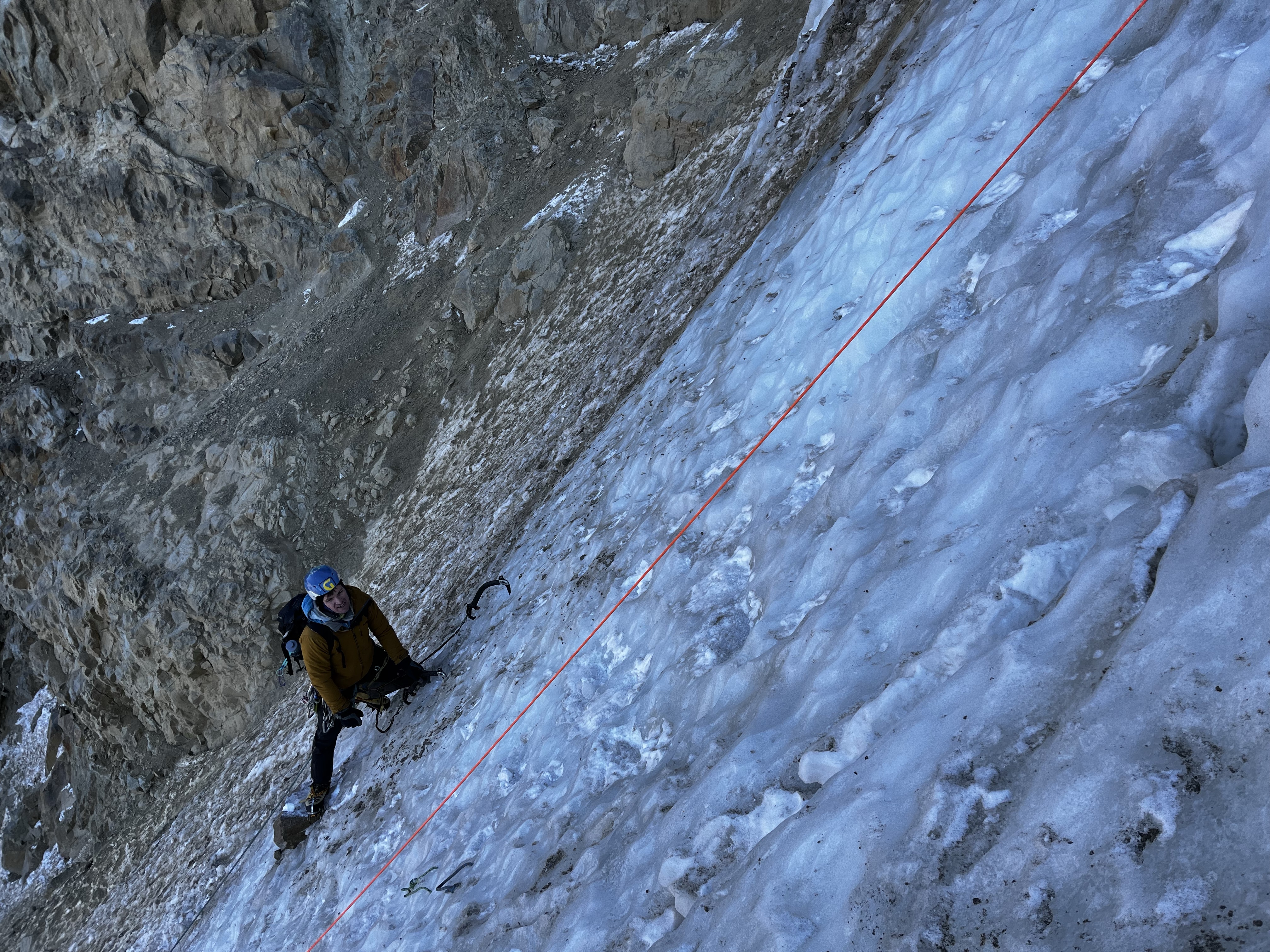

After that belay, you will climb more ice, before the material changes to 40 meters or so of the steep snow emblematic of the Blanca. Pickets to protect the upper face if desired.

The technical section will take two or three pitches, depending on how long your ropes are and how much you feel comfortable soloing or simulclimbing. We did it in two long pitches with double 70 meter ropes.
Once you top out on the ramp, you’ll be in a lower-angle col/depression. Here you can rest, eat, drink, before tackling one more short steep section. We didn’t rope up for this bit, but the guide short-roped his client up it.

After finishing that, you will find yourself on a more traditional, crevassed glacier. It’s a good idea to rope up here, although this year the crevasses were not a big problem. Walk across the plain and head towards the obvious summit, passing a couple more steep sections in the neighborhood of 45-55 degree snow. Protect to your taste.
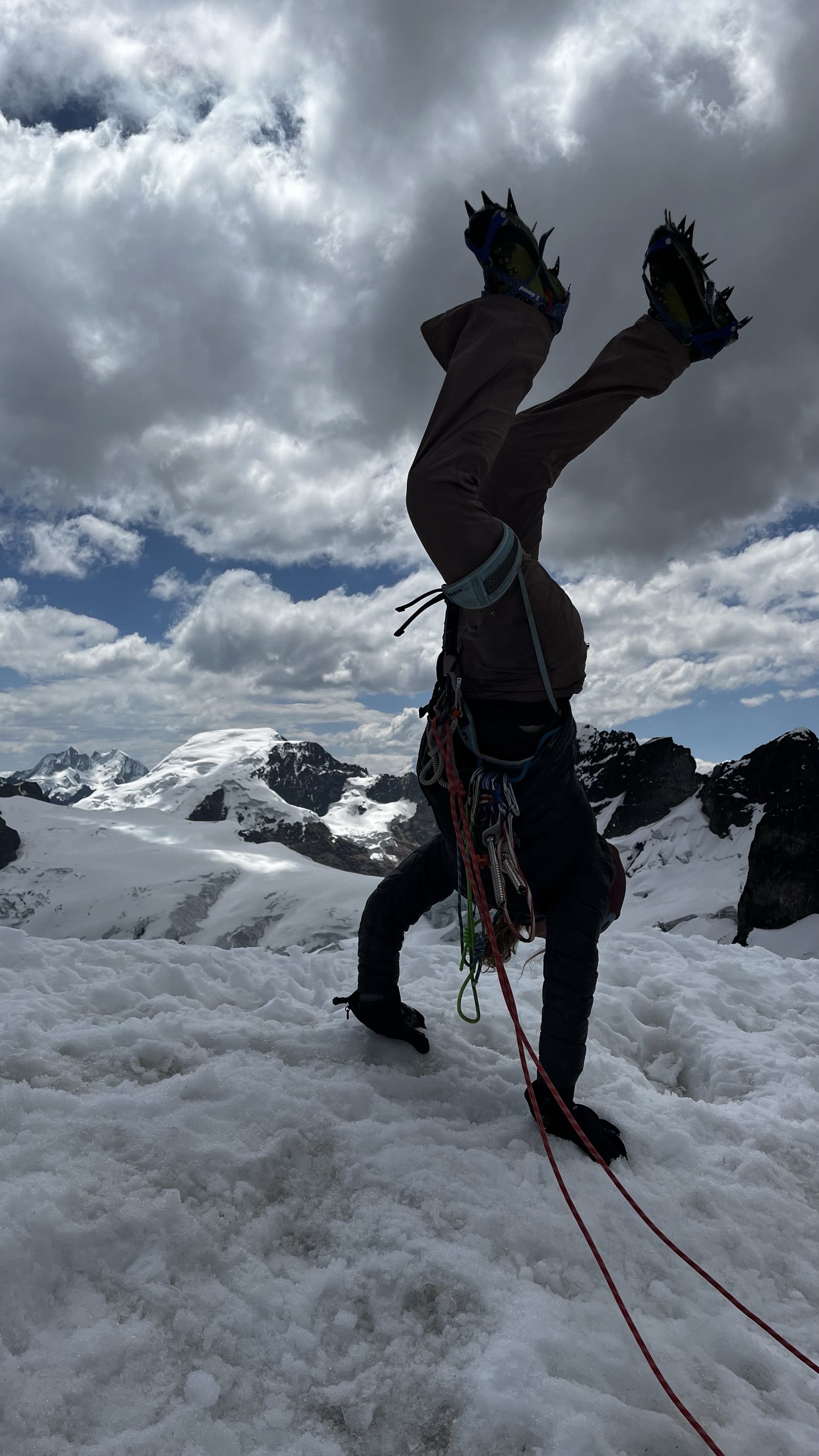
You’ll quickly be on the summit. The summit was a bit hazardous this year, with evidence of several small holes/crevasses, and a large cornice on the leeward side. We hung out well downhill of the ridge proper, which felt like the safe decision. From the top you can enjoy views of the Cordillera Negra, the Cordillera Huaywash, and the Pastoruri glacier. Check out how far away from the parking lot the Pastoruri glacier now sits – an immediate and obvious example of glacial retreat.

The descent

From the summit, reverse your route to the top of the ice shield. Here, you will need to do two double-rope rappels (recommended) or four single-rope rappels to reach the lower-angle snow at the base. We found a previously-constructed snow bollard on the ridge, which we used to rappel. My first time ever rappelling on such a feature! There were also a few fixed snow stakes (pickets, estacas) at various points on the ridge, or you could of course leave one of your own.


The second double-rope rappel is via v-thread (abalakov thread) anchor. As I mentioned the face is full of old v-thread tat, but I would encourage you not to trust these. I constructed a new naked-thread anchor, which maybe freaked my novice followers out a bit. Nonetheless, it got us down and we pulled the rope no problem, leaving the face no worse-looking then when we found it.
From the base of the technical section, coil your ropes and had back to your waiting taxi, who will ferry you back to Huaraz.
Overall

This was a pretty fun mountain, with a reasonable altitude (5,420 meters). This year, it offered a good quantity of honest, technical ice climbing. The short approach makes it an relaxing, non-committing objective, and a competent, acclimatized party should be able to dispatch the mountain in a compact half-day. We took a bit longer than that, but we were five!
If you are not obsessed with summits you could even rappel after just doing the ice pitches.
We also spotted this bonus pitch of WI3 on the way in – a nice dessert!

Climbing Party: Dan K, Jess S, Paul C, Dennis J, Olivia.
Date of climb: August 4, 2023
Grade: AD / WI3.
Photos taken on phones by various members of the climbing party.
 thisisyouth